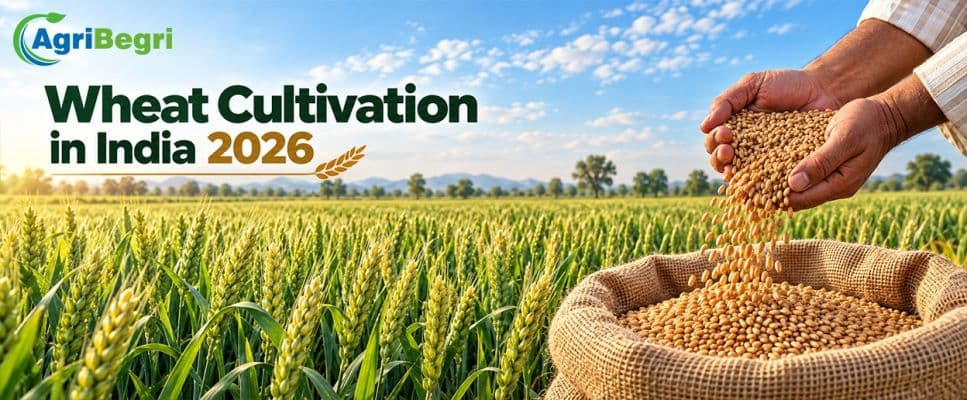
Wheat is the second most important food crop in India after rice. Millions of farmers depend on the wheat crop for their income and daily food, and wheat cultivation in India is what puts that grain on the table. In the 2025-26 season, India produced a record 120.65 million tonnes of wheat, higher than 117.94 million tonnes the year before.
This guide to wheat cultivation in India covers everything in simple language - types of wheat, soil, climate, sowing, irrigation, diseases, and export. Whether you are new to wheat farming in India or want to increase your yield, this article explains wheat cultivation step by step.
Wheat Cultivation Key Takeaways
|
Point
|
Detail
|
|
Crop season
|
Rabi (winter)
|
|
Sowing time
|
October to November
|
|
Harvesting time
|
February to April, depending on the Region
|
|
Ideal temperature
|
10 to 15°C at sowing, 21 to 26°C at ripening
|
|
Rainfall needed
|
50 to 75 cm
|
|
Best soil
|
Well-drained loam and alluvial soil
|
|
Seed rate
|
About 40 to 50 kg per acre
|
|
India's rank
|
2nd largest wheat producer in the world
|
What Is Wheat Cultivation in India?
Wheat cultivation is the process of growing wheat from seed sowing to harvesting. It includes preparing the field, selecting suitable seeds, sowing at the right time, managing irrigation and nutrients, controlling weeds and pests, and harvesting the mature crop. Proper crop management helps maintain healthy plant growth and good grain production.
In India, wheat is mainly grown as a rabi crop during the winter season. Sowing is generally done from October to November, while harvesting usually takes place from March to April, depending on the region and sowing time. The crop generally takes around 120 to 150 days from sowing to harvest. Wheat grows well in fertile, well-drained soil with suitable temperatures and adequate moisture.

Types of Wheat in India
There are many types of wheat grown around the world. In India, wheat cultivation is built around three main types.
|
Type of Wheat
|
Scientific Name
|
Main Use
|
Where Grown
|
|
Bread wheat (common)
|
Triticum aestivum
|
Chapati, bread, bakery items
|
North and Central India (about 95% of Indian wheat)
|
|
Durum wheat
|
Triticum durum
|
Suji, pasta, macaroni
|
Madhya Pradesh, Gujarat, South India
|
|
Emmer wheat (Khapli)
|
Triticum dicoccum
|
Traditional and health foods
|
Maharashtra, Karnataka, Gujarat
|
Bread wheat is by far the most common. Durum wheat is a hard wheat used to make semolina. Emmer wheat (Khapli) is an old variety now popular as a health food.
Some popular high-yielding varieties used in wheat cultivation today are:
- Sharbati Wheat: Premium, naturally sweet variety from Sehore, MP; soft golden grain, ideal for chapatis.
- Khapli Wheat: India's ancient emmer wheat; drought-resistant, low-gluten, high-fibre; grown mainly in Maharashtra and Karnataka.
- Lokwan Wheat: Hard, high-protein variety from central India; popular for milling and quality atta.
- HD-2967: Yields ~20 to 28 q/acre; widely grown across North India; resistant to yellow and brown rust.
- PBW-725: Known for stable performance and strong resistance to yellow and brown rust.
- PBW-826: Newer PAU release with bold, shiny grains; heat-tolerant; yields ~30-35 q/acre, matures a few days early.
- HD-3086 (Pusa Gautami): Consistently high yields under irrigated, timely-sown conditions; strong rust resistance.
- DBW-187 (Karan Vandana): Biofortified, iron-rich; yield potential up to 22-30 q/acre; good heat tolerance.
- DBW-303 (Karan Vaishnavi): High-yielding at ~32-33 q/acre (potential 97.4 q/ha); resistant to leaf rust, stripe rust and wheat blast.
- HD-3226: Yields ~30-33 q/acre (potential ~80 q/ha); highly resistant to rust, Karnal bunt and loose smut; high protein.
Climate and Soil Needed for Wheat Cultivation
Climate Requirement
Wheat is a rabi crop. Wheat cultivation needs cool weather while the crop is growing and warm weather at harvest.
- Temperature: 10 to 15°C helps good germination.
- Warm at ripening: 21 to 26°C helps the grain fill and dry.
- Rainfall: 50 to 75 cm, well spread out. Too much rain or frost at flowering can damage the crop.
- Sunlight: Demands bright, open, sunny days during the grain-filling stage for heavy and plump kernels.
Soil Requirement
- Best soil type: well-drained loam and clay loam that retains moisture without waterlogging
- Drainage: Extremely sensitive to waterlogging; even 1 to 2 days of standing water at the seedling stage can kill the crop
- Other suitable soils (with irrigation): black soil and red loamy soil
- Ideal soil pH: 6 to 7.5
Step-by-Step Wheat Cultivation Process
Follow these steps for good wheat cultivation.
Step 1: Field Preparation
Plough the field 2 to 3 times using a harrow or cultivator, then level it with a planker. A fine, firm, weed-free seedbed helps seeds sprout evenly and quickly.
Step 2: Seed Selection and Treatment
Choose a certified, disease-resistant wheat variety suited to your zone and sowing time. Carry out wheat seed treatment with a recommended fungicide before sowing to protect against seed-borne diseases like loose smut.
Step 3: Sowing
Sowing on time is the single biggest yield factor in wheat cultivation; early to mid-November in the northern plains gives the best results. Keep a seed rate near 100 kg per hectare and prefer line sowing or a zero-till drill.
Step 4: Irrigation
Wheat cultivation needs about 4 to 6 irrigations. The first, at Crown Root Initiation (CRI) around 20 to 25 days after sowing, is most important. Also water at the tillering, flowering, and grain-filling stages.
Step 5: Fertilizer and Nutrients
Apply a balanced dose of nitrogen, phosphorus, and potash based on a soil test. Add zinc if the soil is deficient, and give nitrogen in split doses for better uptake. The right mix of wheat fertilizers and micronutrients is what separates average wheat cultivation from a high-yielding crop.
Step 6: Weed Control
Weeds are the silent yield thief in wheat cultivation. Remove them early, as broad-leaf and grassy weeds compete for food, water, and light. Use the right herbicide within 30 to 35 days of sowing, or do timely manual weeding.
Step 7: Disease and Pest Control
Check the crop regularly for rust, aphids, and termites. Spray a recommended fungicide or insecticide at the first sign of attack, and always follow the label dose.
Step 8: Harvesting and Storage
Harvest when the grain is hard and the crop turns golden, usually March to April. Dry grain well to about 12 to 13% moisture before storing to prevent fungus and insect damage.
Wheat Production in India and Major Wheat Producing States
India produced a record 120.65 million tonnes of wheat in 2025-26, according to the Ministry of Agriculture's third advance estimate released in May 2026 — about 2.71 million tonnes more than the previous year's 117.94 million tonnes, a rise of 2.29%. India's yield is close to the world average but still well behind France and China, so there is room to improve with better seed and management
Major Wheat Producing States in India
Wheat cultivation in India is spread across several states, but a handful of them contribute the largest share of the country's total production.
|
Rank
|
State
|
Production
|
|
1
|
Uttar Pradesh
|
35.87 million tonnes
|
|
2
|
Madhya Pradesh
|
24.51 million tonnes
|
|
3
|
Punjab
|
17.99 million tonnes
|
|
4
|
Haryana
|
11.40 million tonnes
|
|
5
|
Rajasthan
|
11.27 million tonnes
|
Other states with growing wheat cultivation include Gujarat, Maharashtra, West Bengal, and Uttarakhand.
Common Wheat Diseases and Their Control
Wheat diseases can cut your yield badly if not controlled early. Disease management is the weakest link in most wheat cultivation. Here are the common ones.
The best defense in wheat cultivation is a resistant variety plus seed treatment before sowing. If rust appears, spray a recommended fungicide at once and repeat if needed. Always follow the label dose.
Wheat Export from India
For a long time, wheat export from India was stopped. The government banned wheat exports on May 13, 2022, to control prices and protect food stock.
Because of record production and large government stocks, the ban was lifted on 24 August 2026. Wheat and wheat products (flour, maida, suji) were moved from the "prohibited" to the "free" export category. This opens new markets for Indian farmers and traders and can make wheat cultivation more profitable at the farm gate. The minimum support price (MSP) for wheat was Rupees 2,585 per quintal for the 2025-26 marketing season.
Conclusion
Wheat cultivation in India is the backbone of the country's food security. With the right variety, good soil, timely sowing, proper irrigation, and early disease control, you can get a strong yield from your wheat crop. India's record production and the reopening of wheat exports from India show that wheat cultivation in India has a bright future. Follow the simple steps in this guide to wheat cultivation, keep an eye on wheat diseases, and your wheat cultivation can become more profitable season after season.