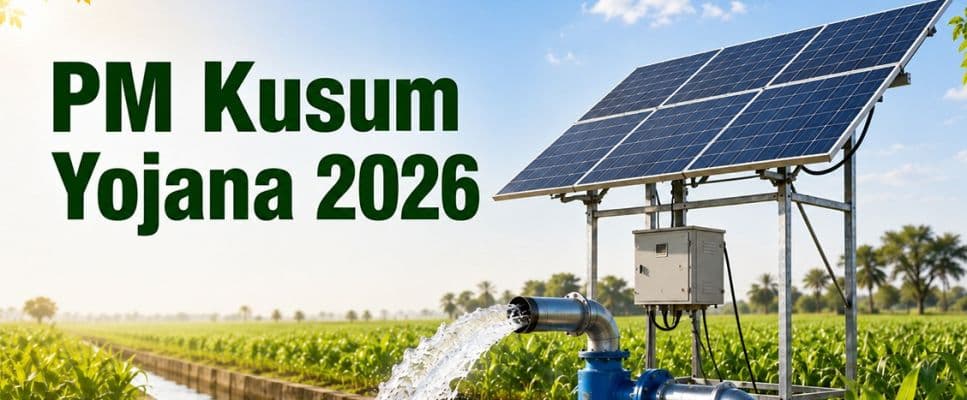
For Indian farmers, energy is as essential to a good harvest as water and soil. Yet for years, irrigating a field has meant depending on an erratic power supply or burning expensive diesel — an unreliable routine that quietly eats into already thin margins. The PM Kusum Yojana was launched to change exactly that: by bringing solar power straight onto the farm, it aims to make energy cleaner, cheaper, and far more dependable for rural India.
Formally known as the Pradhan Mantri Kisan Urja Suraksha evam Utthaan Mahabhiyan, the scheme does far more than run a few pumps. It treats solar energy as a way to secure a steady income, guarantee daytime irrigation, and build a more sustainable future for farming.
So how does it actually deliver on all this? It helps to start with the basics — what the PM Kusum Yojana really is, and how it works on the ground.
What is PM Kusum Yojana?
PM Kusum Yojana — short for Pradhan Mantri Kisan Urja Suraksha evam Utthaan Mahabhiyaan — is a central government scheme launched by the Ministry of New and Renewable Energy (MNRE) to promote solar energy across India's agricultural sector. Its core purpose is to help farmers move away from expensive diesel pumps and an unreliable grid supply by giving them access to clean, solar-powered electricity for irrigation and other farm needs.
Under the PM Kusum scheme, the government provides subsidies that make it affordable for farmers to install solar pumps and set up decentralized solar power plants. Broadly, PM Kusum supports three things: building small solar power plants on barren or unused land, installing standalone solar pumps, and solarizing existing grid-connected agricultural feeders and pumps. Together, these measures reduce diesel consumption, lower electricity costs, and make farmers significantly more energy-secure.
What sets PM Kusum scheme apart from earlier agricultural power programs is its dual benefit. Farmers can not only use solar power to meet their own requirements but, in many cases, also earn extra income by selling surplus electricity back to the grid.
Objectives of PM Kusum Yojana
The central aim of PM Kusum Yojana is to make Indian agriculture energy-independent and environmentally sustainable by replacing diesel and grid power with solar energy. To achieve this, the scheme works toward a few clear objectives:
- Boosting farmer income — Farmers can put barren or cultivable land to productive use by setting up solar power plants and selling the surplus electricity to DISCOMs, creating a steady, supplementary source of income.
- Energy and water security — The scheme gives farmers reliable daytime power for irrigation, freeing them from an erratic grid and the rising, unpredictable cost of diesel.
- De-dieselization of agriculture — By promoting standalone solar pumps, PM Kusum scheme aims to remove polluting diesel from farm irrigation altogether.
- Easing the subsidy load on states — Shifting irrigation to solar lowers the heavy electricity and fuel subsidy costs carried by state governments and strengthens the financial health of local DISCOMs.
- Tackling climate change — Moving farm operations from fossil fuels to clean, renewable energy cuts significant carbon emissions and supports India's wider climate commitments.
PM Kusum Yojana Components
The PM Kusum Yojana is implemented through three major components that are designed to meet different needs of Indian farmers.
|
PM Kusum Component
|
Focus Area
|
Capacity
|
Eligibility
|
Financial Support / Subsidy
|
Outcome for Farmers
|
|
Component A: Solar Power Plants
|
Setting up small-scale, grid-connected renewable energy power plants on barren, fallow, or agricultural lands.
|
0.5 MW to 2 MW per project
|
Farmers, FPOs, cooperatives, panchayats, solar developers
|
Up to 60% (30% Central + 30% State), Up to 30% bank loan, 10% farmer share
|
Earn regular income by selling solar power or leasing land to developers
|
|
Component B: Standalone Solar Agriculture Pumps
|
Installation of off-grid standalone solar pumps to irrigate areas where the power grid has not reached.
|
Up to 7.5 HP
|
Farmers in remote, off-grid, or unreliable grid areas
|
Up to 60% subsidy, 30% bank loan, balance by farmer; lowers irrigation costs
|
No more diesel costs, free solar-powered irrigation for 25+ years
|
|
Component C: Grid Pump Solarisation
|
Solarizing existing grid-connected agricultural pumps to help farmers run them using solar energy rather than relying solely on the grid.
|
Up to 7.5 HP
|
Farmers with existing grid-connected agriculture pumps
|
Subsidy and loan structure similar to Component B
|
Sell extra solar power to DISCOM and cut expensive grid electricity bills
|

What is the Subsidy under PM Kusum Yojana?
The PM Kusum scheme offers one of the highest subsidy structures among all government schemes for farmers. Here is the detailed breakdown.
|
Subsidy Source
|
Standard States
|
North-East & Special States
|
|
Central Government
|
30%
|
50%
|
|
State Government
|
30%
|
30%
|
|
Farmer Contribution
|
10%
|
10%
|
|
Bank Loan (Optional)
|
Up to 30%
|
Up to 10%
|
|
Total Subsidy
|
60%
|
80%
|
States Eligible for 80% Subsidy
- All 8 North-Eastern states
- Sikkim
- Jammu & Kashmir
- Ladakh
- Himachal Pradesh
- Uttarakhand
- Lakshadweep
- Andaman & Nicobar Islands
PM Kusum Yojana Benefits for Farmers
PM Kusum scheme gives farmers a mix of financial, practical, and long-term benefits — from heavily subsidised solar pumps to a dependable new source of income. The key benefits include:
- Affordable solar pumps through heavy subsidies: up to 60% of the cost is covered by central and state government subsidies, about 30% can be financed through a bank loan, and the farmer pays only around 10%.
- Freedom from diesel and electricity bills: solar pumps remove the need for costly diesel or grid power for irrigation, which is especially valuable in remote areas that have little or no access to electricity.
- A steady extra income for up to 25 years: farmers can put barren or unused land to work — setting up a small solar power plant (0.5 MW to 2 MW) or leasing the land for one — and earn a fixed income for up to 25 years by selling the electricity to the grid.
- Earnings from surplus power: once their own irrigation needs are met, farmers can sell any leftover solar power to the local DISCOM for additional income.
- Reliable daytime power and energy security: assured daytime solar power for irrigation ends the dependence on an unpredictable grid and frequent outages.
- More time for productive work: with power available during the day, farmers no longer have to irrigate at odd hours, freeing them up for other farm and income-generating activities.
- Better crop outcomes: consistent, dependable irrigation supports healthier crops and improved yields.
- Lower operational stress: with less reliance on diesel supply and fewer grid outages, day-to-day farming becomes more predictable and far less stressful.
Did You Know? A 5 HP solar pump under PM Kusum saves approximately ₹40,000 to ₹60,000 per year in diesel cost — paying back the farmer's contribution within 2 to 3 years of installation.
PM Kusum Yojana Eligibility Criteria 2026
To apply for the PM Kusum scheme, farmers must meet the following eligibility criteria:
Who Can Apply
- Individual farmers owning agricultural land
- Group of farmers or farmer cooperatives
- Farmer Producer Organisations (FPOs)
- Panchayats (mostly for Component A projects)
- Water User Associations (WUAs)
- Self Help Groups (SHGs) of farmers
- Solar power developers (for Component A, with farmer land lease arrangement)
PM Kusum Yojana Online Registration - How to Apply for PM Kusum Yojana
Farmers can apply for the PM Kusum scheme online in one of two ways — through the central portal of the Ministry of New and Renewable Energy (MNRE) at pmKusum.mnre.gov.in, or through their respective state's agriculture or energy department website, since the application is handled at the state level in many cases.
Before starting, applicants should keep a few key documents ready: an Aadhaar card, land ownership papers (land deed), and a bank passbook. The Kusum yojana online registration process is straightforward:
- Visit the official website: Go to the MNRE PM-Kusum portal, or your state's designated agriculture/energy department website.
- Registration: Click on the 'Apply Online' link and select your state.
- Fill in the form: Enter the required details, including your name, address, land details, and the solar capacity you need.
- Upload documents: Attach the necessary documents, such as your Aadhaar card, land papers, and bank account details.
- Submit: Review the information and submit the form to complete your registration.
Documents Required for PM Kusum Yojana Registration
- Aadhaar Card linked to mobile number and bank account
- Land ownership records (Khasra, Khatauni, Jamabandi, 7/12 extract) or land lease agreement
- Bank passbook or cancelled cheque with IFSC code
- Passport-size photograph
- Self-declaration of not previously availing any solar pump subsidy
- Electricity connection or pump details (for Components B and C)
- Caste certificate (for SC/ST applicants claiming additional subsidy)
- Authorisation letter or resolution (for FPOs, cooperatives, Panchayats, or WUAs)
- Site photographs or technical details of proposed installation (where required by State Nodal Agency)
PM Kusum Yojana Application Status Check
After submitting your application, you can check the status online any time.
Steps to Check PM Kusum Status
- Visit your State Nodal Agency Portal or pmKusum.mnre.gov.in
- Click on "Login" or "Track Application Status"
- Enter your Application Number or registered mobile number
- Click "Submit"
- Your current status will appear — Pending, Under Verification, Approved, or Rejected
Important: Save your Application ID in your phone or in writing immediately after registration. Without it, you cannot track your application or claim the subsidy later.
PM Kusum 2.0 — Upcoming Changes & Battery Storage Integration
PM-Kusum 2.0 is the upcoming, upgraded phase of India's flagship agricultural solar scheme. Backed by a proposed budget of around ₹50,000 crore — a significant jump from the current allocation — the revamp is meant to widen the reach of clean energy across villages and smooth out the hurdles that held back the original scheme. As MNRE extends the completion deadlines for existing Phase 1 projects, the comprehensive rollout of PM-Kusum 2.0 is being prepared and is widely anticipated, though it is yet to be formally notified.
The new phase is expected to introduce several major upgrades:
- A planned 10 GW agrivoltaics component would mount panels high enough that farming can continue underneath them, letting a single plot yield both a harvest and electricity — an arrangement that also eases farmers' reluctance to commit land to solar.
- Battery Energy Storage Systems (BESS): Battery systems are expected to be built in, holding back the surplus electricity generated in the bright midday hours so it can be drawn on later in the evening, when fields still need power but sunlight has faded.
- Expanded budget: A proposed increase to around ₹50,000 crore to accelerate installations and clear pending waiting lists.
- Tighter checks on contractors: Firms handling the engineering and installation may be required to furnish bank guarantees, shielding farmers from systems that are left incomplete or that fail to perform.
PM Kusum Yojana Helpline Number
Toll-free helpline: 1800-180-3333
Email: pmKusum-mnre@gov.in
Official portals
State-level help
-
State Nodal Agency — the body that handles PM Kusum scheme in your state. This differs from state to state, so check the state agency table above.
-
District Renewable Energy Officer (DREO) — your nearest contact at the district level.
-
DISCOM customer service — for Component C matters, such as solarising grid-connected pumps.
-
Local Common Service Centre (CSC) — for hands-on help completing and submitting your application.