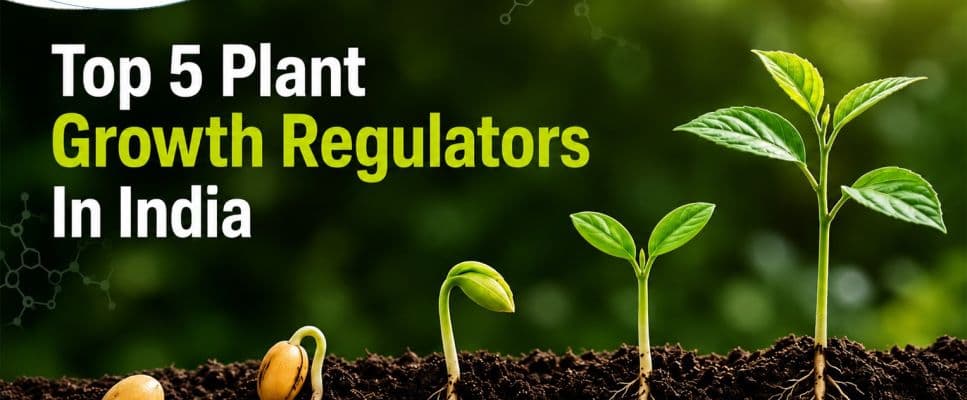
Farming today is much more than simply sowing seeds and waiting for harvest. Farmers now focus on using better techniques and modern inputs to get higher yields, improve crop quality, and deal with problems such as poor flowering, fruit drop, and uneven growth. One such input that has gained a lot of attention in recent years is the plant growth regulator (PGR).
Many farmers have heard about Plant Growth Regulators and may even be using them in crops like vegetables, fruits, and cereals. However, with so many products available in the market, it can be difficult to know which ones actually work and where they should be used. In this article, we take a look at the top five plant growth regulators used in India, their major benefits, and the crops in which they are commonly recommended.
What Are Plant Growth Regulators (PGRs)?
Plant Growth Regulators (PGR) are natural or synthetic chemical compounds that act as plant hormones. They are not fertilizers and do not provide nutrients. Instead, they manage key activities like cell division, root formation, flowering, fruit development, and plant height — working much like a signalman who decides which train moves and when.
Different crops need different growth support at different stages. One crop may need early flowering, another may need to slow down leafy growth, while a third may need better fruit setting or bigger fruit size. Nature gives some help through sunlight, air, water, and soil nutrients, but plant hormones and regulators handle the finer control of germination and development.
In simple words, a plant growth regulator works like a health tonic for crops. They may contain hormones such as auxins, gibberellins, and cytokinins, or natural ingredients like seaweed extract, amino acids, and humic substances. Because they improve yield and quality without needing extra land, PGRs have become an important tool in modern farming.
Important: Plant growth regulator is not a fertilizer. Fertilizer gives nutrition (NPK). PGR gives growth signals. Both are needed, but they work in completely different ways. Think of it like this — fertilizer is the food, PGR is the coach that tells the plant how to use that food better.

Benefits of Plant Growth Regulators in Agriculture
Plant growth regulators offer several real, measurable advantages for Indian farmers — especially those dealing with unpredictable weather, rising input costs, and small landholdings. These are not lab-level claims. These are results that farmers across India see at harvest time.
Below are the key benefits of using PGR for plants on your farm.
1. Increased Crop Yield Per Acre
This is the biggest reason Indian farmers use plant growth regulators. Plant growth regulators promote cell division inside the plant, which directly results in more biomass, more flowers, and higher overall production. The result? A higher number of marketable produce per acre.
For a farmer working on just 1-2 acres, even a 10-15% yield boost can mean ₹5,000 to ₹15,000 extra income per season — without increasing land or labour.
Research across Indian crops like rice, wheat, potato, tomato, chickpea, and onion has shown clear yield improvements when PGRs are applied at the correct growth stage.
2. Better Stress Management
With rising temperatures and irregular rainfall, stress tolerance has become critical for Indian crops. Plant growth regulators help crops withstand three major types of stress:
- Drought stress — PGRs enhance cuticle development (the waxy protective layer on leaves) and help plants rapidly close their stomata (tiny leaf pores) during extreme heat. This prevents water loss and helps the crop survive dry spells even when irrigation is delayed or insufficient.
- Heat stress — Certain PGRs improve a plant's internal defence system by boosting antioxidant activity, protecting cells from heat damage caused by high temperatures.
- Salinity stress — In areas with saline soil or brackish irrigation water, PGRs strengthen the plant's ability to absorb water and nutrients even under difficult conditions.
If your area faces unpredictable weather — and most of India does now — PGR for plants act as a protective shield for your crop.
3. Improved Crop Quality
Plant growth regulators promote cell enlargement in developing fruits and vegetables, resulting in larger, more uniform, and better-shaped produce. They also improve colour development and skin finish — the visual factors that matter most at the mandi.
Bigger, uniform, good-looking fruits and vegetables always get a higher rate per kilogram. Buyers — whether at the local mandi, in retail chains, or in export markets — are willing to pay a premium for produce that looks better and weighs more. Quality improvement is one of the most visible and immediate benefits a farmer notices after using PGRs.
4. Enhanced Nutrient Efficiency
Here is something most farmers do not realise: PGRs can make your existing fertilisers work harder.
By improving nutrient uptake at the cellular level, plant growth regulators reduce fertilizer wastage and increase nutrient use efficiency. That means the urea, DAP, or potash you are already applying gets absorbed more effectively by the crop. The plant converts more of each input into actual growth instead of letting it wash away.
You may not need to increase fertilizer doses at all. Just adding the right PGR at the right stage can help the plant pull more nutrition from the same amount of input. This saves money and also reduces environmental harm from excess fertilizer runoff.
5. Prevention of Premature Fruit and Flower Drop
This is a painful and expensive problem — especially for mango, citrus, cotton, and chilli farmers. The plant flowers beautifully, small fruits start to form, and then they start dropping before maturity.
PGRs strengthen the bond between the fruit and the branch. They signal the plant to hold on to its developing fruits instead of shedding them. Less drop means more marketable produce from the same number of plants — without any extra input cost.
6. Faster and More Uniform Ripening
When all the fruits on a plant ripen at the same time, you can harvest in one go instead of making multiple picking rounds. This saves labour cost and helps you hit the market when prices are best.
PGRs that promote uniform ripening are especially useful for banana, tomato, coffee, and sugarcane farmers. For sugarcane specifically, the right PGR can increase sugar content before harvest — which means better payment per tonne at the sugar mill.
The labour saving angle matters more than most farmers realise. In Indian agriculture, labour is becoming expensive and hard to find — especially during peak harvest season. PGRs reduce your dependence on labour in several ways:
- Uniform ripening means one or two harvests instead of five or six picking rounds
- Controlled plant growth (less excess branching) means less pruning and training work
- Better crop uniformity reduces the time spent on sorting and grading after harvest
For farmers managing even 2-3 acres, these labour savings can add up to ₹3,000 to ₹8,000 per season.
7. Stronger Root Development and Propagation Success
A plant with a weak root system will always underperform — no matter how much fertilizer or water you provide. Plant growth regulators promote faster root growth, better root branching, and deeper root penetration. More roots mean better nutrient and water absorption from the soil.
PGRs also stimulate adventitious rooting — the formation of new roots from stem cuttings, which makes vegetative propagation far more effective. This is a huge advantage for nursery growers and farmers who multiply plants through cuttings rather than seeds.
This benefit is especially important for:
- Transplanting of seedlings (tomato, chilli, brinjal, flower crops) — treated seedlings establish faster and suffer less transplant shock
- Nursery operations — cuttings of rose, grape, pomegranate, and other crops root faster and more reliably with PGR treatment
- Early crop establishment in fields with poor soil structure — stronger roots help the plant anchor and access deeper moisture
8. Better Seed Germination and Early Crop Establishment
Slow or uneven germination wastes time and reduces your plant population per acre. PGR seed treatment — soaking seeds in a dilute solution before sowing — breaks seed dormancy and promotes fast, uniform sprouting.
This gives your crop a head start, which is especially valuable in late-sown conditions where the growing window is already short (like late-planted sugarcane, wheat, or rabi vegetables).
9. Control Over Flowering Timing
With the right plant growth regulators, you can influence when your crop flowers. This is a game-changer for several crops:
- Pineapple — PGRs can force uniform flowering across the entire field
- Mango — Used for off-season (bahar) flowering management
- Ornamental flowers — Timing the bloom for festivals like Diwali, weddings, or export windows can double the selling price
Controlling the flowering window means you can target market periods when supply is low and prices are high. This turns PGR from a farming input into a marketing tool.
10. Improved Post-Harvest Quality and Shelf Life
The benefits of plant growth regulators do not stop at the farm gate. Crops treated with the best PGRs at the right time often have noticeably better post-harvest life.
Fruits are firmer, colours are more vibrant and uniform, and produce withstands transport better — less bruising, less rotting, less wastage during transit. For farmers who sell to distant mandis, retail chains, or export buyers, this means fewer rejections and more profit per consignment.
Top 5 Plant Growth Regulators in India
Here is a detailed plant growth regulators list featuring some of the best plant growth promoters in India. These are among the most widely used PGRs in agriculture across India today.
1. Agrigib Plant Growth Regulator
Agrigib contains Gibberellic Acid 0.001% L, one of the most widely used plant hormones in Indian agriculture. It promotes seed germination, stem elongation, and improved flowering and fruiting across all crop types.
Key Benefits:
- Improves seed germination and early growth
- Reduces flower and fruit drop
- Increases overall crop quality and yield
Best For: Paddy, Grapes, Brinjal, Okra, Cotton
2. Bayer Ethrel Plant Growth Regulator
Bayer Ethrel contains Ethephon 39% SL that releases ethylene inside the plant, the natural hormone responsible for ripening and maturity. It gives farmers complete control over harvest timing and fruit colour.
Key Benefits:
- Promotes uniform fruit ripening
- Induces flowering in off-season crops
- Improves fruit colour and market value
Best For: Mango, Pineapple, Tomato, Cotton, Banana
3. Pellot Plant Growth Regulator
Pellot contains Paclobutrazol 23% SC, a growth regulator that controls excessive vegetative growth and redirects the plant's energy towards flowering and fruiting. It is especially popular in mango orchards for inducing early and uniform flowering.
Key Benefits:
- Controls excess vegetative growth in tall crops
- Redirects plant energy towards flowering and fruiting
- Improves crop uniformity and quality
Best For: Mango, Soybean, Cotton, Groundnut
4. Fantac Plus Plant Growth Regulator
Fantac Plus is a growth regulator that directs plant energy towards flowering, fruiting, and produce quality. It is especially effective for improving the overall quality of the fruits.
Key Benefits:
- Improves fruit size, weight, colour, and shine
- Supports stress recovery through protein synthesis
- Enhances nutrient absorption efficiency
Best For: Potatoes, Vegetables, Fruits, Cereals, Pulses
5. Syngenta Quantis Biostimulant
Syngenta Quantis is a biostimulant that helps crops recover from stress caused by heat, drought, or irregular weather. It keeps the plant active and healthy during difficult conditions, protecting yield even when the weather is unfavourable.
Key Benefits:
- Protects crops from heat and drought stress
- Helps plants recover quickly after weather damage
- Improves yield and produces better quality crops
Best For: Soybean, Cotton, Rice, Wheat, Sugarcane
How to Choose the Right Plant Growth Regulator for Your Crop
Choosing the right Plant growth regulator depends mainly on three things — your crop's growth stage, your farming goal, and your local climate. The best approach is to first decide what you want to achieve, then pick a PGR that matches that need, and always stick to the recommended dose to keep your crop safe. Here is a simple way to decide.
1. Decide Your Farming Goal First
Different plant hormones work on different stages of growth, so match your choice to your aim:
- For growth promotion — Use auxins, gibberellins, or cytokinins. These help in seed germination, faster cell growth, bigger fruit size, and longer shoots.
- For controlling extra growth — Use growth retardants like abscisic acid (ABA). These stop the plant from becoming too tall or leggy, encourage branching, and push energy into roots and flowers.
- For ripening — Use ethylene-based regulators to ripen fruits together and manage flower or fruit drop.
2. Match the Plant growth regulator to the Growth Stage
- Seed or seedling stage — Helps early root and shoot growth, giving the crop a strong start.
- Vegetative stage — Improves leaf area, stem length, or side branching.
- Flowering and fruiting stage — Improves flower holding, better fruit setting, and final fruit size.
Applying the right PGR at the wrong stage wastes money and may even harm the crop, so timing matters a lot.
3. Consider Your Local Climate
Your weather decides how much stress support your crop needs:
- For stress recovery — After heavy rain, drought, or extreme heat, cytokinin-based PGRs or amino acid stress complexes help the plant recover, restore greenery, and rebuild its natural defence.
- For lodging protection — In high-rainfall areas, certain PGRs keep the plant from bending or falling over, which protects both yield and quality.
4. Get the Dosage, Timing, and Method Right
Even the best PGR can damage a crop if used wrongly. Keep these points in mind:
- Application method — Choose between a foliar spray (sprayed on the leaves) or a soil drench (applied near the roots), based on your crop and field layout.
- Concentration — Always begin with the lowest recommended dose. Re-applying is easy, but reversing an overdose is very hard.
- Trial first — Test the PGR on a few plants before treating the whole field, so you can check the result without risking the entire crop.
Important: Always read the product label and follow the recommended dose and timing. If you are unsure, consult your local agriculture officer or a Krishi Vigyan Kendra (KVK) before spraying. Correct use gives the best results — overuse can stunt or burn your crop.
How to Apply Plant Growth Regulators Correctly
Follow these steps every time you use any plant growth regulator:
Step 1: Read the product label carefully. Check the crop name, dosage, dilution ratio, and application timing.
Step 2: Measure the correct dose. Use a measuring cup or syringe. Do not guess. PGRs work in very small amounts — even a small overdose can damage the crop.
Step 3: Mix with clean water. Use clean, pH-neutral water. Hard or alkaline water can reduce effectiveness.
Step 4: Spray at the right time. Early morning (before 10 AM) or late evening (after 4 PM) is best. Avoid spraying in hot sun or during rain.
Step 5: Cover the plant properly. Use a fine mist nozzle. Make sure the spray reaches all leaves, flowers, and developing fruits.
Step 6: Do not mix with strong pesticides unless the label says it is compatible. Some chemicals can deactivate the PGR.
Step 7: Observe the crop for 7-10 days. You should see visible results within 1-2 weeks. If not, check if the dose or timing was correct.