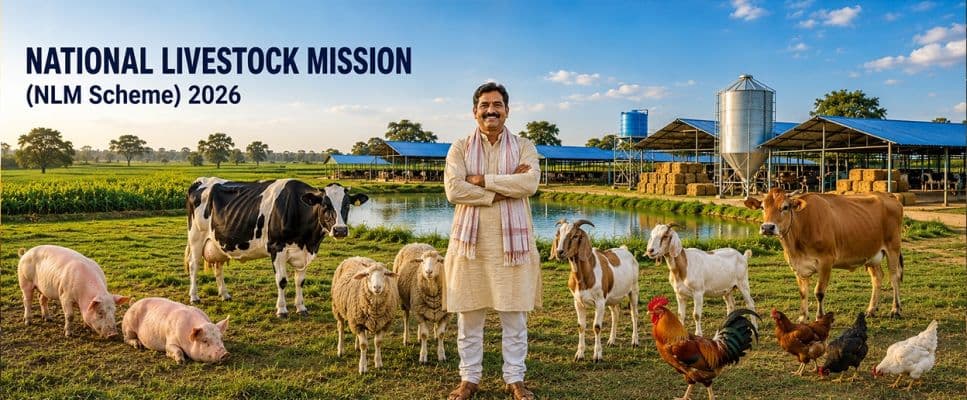
India is home to the world's largest livestock population, yet millions of small farmers still struggle with low productivity, poor breeds, and lack of capital to scale up. To solve this, the Government of India launched the National Livestock Mission (NLM) — a flagship scheme that promotes entrepreneurship and breed improvement in the livestock sector.
Under the NLM scheme, farmers, entrepreneurs, SHGs, FPOs, and JLGs can get up to 50% capital subsidy to start or expand a poultry, goat, sheep, pig, or fodder unit. This complete guide covers NLM subsidy details, eligibility, required documents, and the step-by-step online application process.
Key Takeaways - NLM Scheme
- NLM gives a 50% capital subsidy for livestock businesses.
- Maximum subsidy: ₹25 lakh (poultry), ₹50 lakh (goat/sheep), ₹30 lakh (piggery).
- Open to individuals, FPOs, SHGs, JLGs, FCOs, and Section 8 companies.
- You need training/experience, land, and a bank loan sanction to qualify.
- Apply only online at nlm.udyamimitra.in
- Subsidy is paid in two equal installments and adjusted against your loan.
- No fee to apply; avoid agents promising guaranteed approval.
What is the National Livestock Mission?
The National Livestock Mission (NLM) was launched in 2014–15 by the Department of Animal Husbandry and Dairying (DAHD), Ministry of Fisheries, Animal Husbandry and Dairying, and revised in 2021–22 to focus more strongly on entrepreneurship, breed improvement, and feed & fodder production.
It is a centrally sponsored scheme with a total outlay of ₹2,300 crore, aimed at creating rural jobs and increasing the production of meat, egg, goat milk, wool, and fodder across India.
NLM scheme follows a back-ended capital subsidy model. You take a term loan from a bank for your livestock project, and the government releases 50% of the project cost as subsidy through SIDBI, paid to your bank in two installments. In February 2024, the Union Cabinet also expanded NLM to include horse, donkey, mule, and camel breeding.

National Livestock Mission Objectives
The NLM scheme is built around a clear set of objectives defined by the Government of India:
- Generate employment through entrepreneurship development in small ruminant, poultry, piggery, and fodder sectors.
- Increase per-animal productivity through scientific breed improvement programs.
- Increase production of meat, egg, goat milk, wool, and fodder.
- Improve fodder and feed availability by strengthening the fodder seed supply chain and certified seed production.
- Encourage establishment of fodder processing units to reduce the demand-supply gap.
- Promote risk management measures, including comprehensive livestock insurance for farmers.
- Promote applied research in poultry, sheep, goat, feed, and fodder production.
- Strengthen extension services and build the capacity of state functionaries and livestock owners to provide quality extension services to farmers.
- Promote skill-based training through advanced technologies to reduce production costs and improve livestock sector productivity.
Benefits of the National Livestock Mission
NLM scheme gives many real benefits to farmers and rural entrepreneurs:
- Capital subsidy up to 50%: Get up to 50% of your project cost as subsidy, with a maximum subsidy ceiling of ₹50 lakh, depending on the livestock sector (poultry, goat, sheep, pig, or fodder)
- Fully online application process: No need to visit government offices; complete registration and submission digitally.
- Open to all beneficiary types: Individuals, Farmer Producer Organizations (FPOs), Self-Help Groups (SHGs), Joint Liability Groups (JLGs), and Section 8 companies.
- Breed improvement for higher productivity: Focuses on genetic upgrades for sheep, goats, pigs, and rural poultry, boosting per-animal output of meat, wool, eggs, and milk
- Affordable livestock insurance: Farmers pay only 15% of the insurance premium, while the remaining 85% is shared by the Central and State Governments as per the applicable funding pattern (typically 60:40 or 90:10, depending on the state), ensuring comprehensive risk protection.
- Enhanced fodder availability: Support for silage-making units, and certified fodder seed chains to ensure reliable, high-quality feed supply.
- Subsidy adjusted against loans: The capital subsidy is deducted from your bank loan amount, reducing your overall borrowing burden and EMI.
Three Sub-Missions Under NLM Scheme
The NLM scheme works through three sub-missions, each with a different focus.
1. Breed Development of Livestock and Poultry
Promotes entrepreneurship and breed improvement in poultry, sheep, goat, and piggery through capital subsidies for individuals, FPOs, FCOs, JLGs, SHGs, and Section 8 companies. Since February 2024, it also covers horse, donkey, mule, and camel breeding, and funds State Governments for breed infrastructure.
2. Feed and Fodder Development
Strengthens the certified fodder seed chain and offers subsidies to entrepreneurs and start-ups for setting up fodder Blocks, Hay Baling, and Silage Making units — helping fix the shortage of quality feed across many states.
3. Innovation and Extension
Funds applied research, livestock insurance, extension activities, and innovation in the sheep, goat, pig, and feed & fodder sectors. It supports ICAR institutes, university farms, and central agencies for R&D, seminars, and IEC (awareness) programs
NLM Scheme Sub-Categories by Animal & Activity
Depending on what animal you want to raise, the NLM scheme offers different subsidies and unit sizes. Below is a breakdown for each livestock activity:
NLM Scheme for Poultry Farming
The NLM scheme for poultry farming supports parent farms, rural hatcheries, and brooder-cum-mother units with a minimum of 1,000 parent birds. Low-input birds suitable for free-range rearing are promoted. You get a 50% subsidy up to ₹25 lakh per unit. Funded items include shed construction, brooders, feeders, drinkers, incubators, and parent stock.
NLM Scheme for Goat Farming
The NLM Goat Scheme is one of the most popular options. You set up a breeding unit of 500 females + 25 males, but smaller units (like 100+5) are also allowed. The subsidy covers sheds, sick pens, good breeding stock, and equipment. You can get up to ₹50 lakh subsidy. Goat farming has strong demand and low feed cost, making it ideal for small farmers.
NLM Scheme for Sheep Farming
The NLM sheep farming scheme works just like goat farming — both fall under the "small ruminants" category. You need 500 females + 25 males (smaller units allowed), and you can get up to ₹50 lakh subsidy. is best suited for wool and meat-producing regions.
NLM Scheme for Piggery
The piggery component supports pig breeding farms with a minimum of 100 sows + 25 boars. You can get up to ₹30 lakh subsidy. A smaller 50+5 unit qualifies for up to ₹15 lakh. Pig farming gives fast growth and high meat output, so it suits areas with strong pork demand.
NLM Scheme for Equine and Others
Since February 2024, the scheme also supports breeding farms for horses, donkeys, mules, and camels, with a 50% subsidy up to ₹50 lakh per unit. Individuals, FPOs, SHGs, JLGs, FCOs, and Section 8 companies can apply. These enterprises help diversify livestock activities in hilly, arid, and border regions and open new income opportunities for farmers.
NLM Scheme for Fodder and Feed
This part supports fodder value-addition and storage units for hay, silage, Total Mixed Ration (TMR), and fodder blocks. You also get support for fodder seed processing infrastructure, including grading and storage facilities. You receive a 50% subsidy up to ₹50 lakh. It helps you supply quality feed to other farmers, run a steady business, and fix local feed shortage.
National Livestock Mission Eligibility Criteria
Who Can Apply
The NLM scheme is open to a wide group. You can apply if you are:
- An Individual farmer or entrepreneur
- A Farmer Producer Organisation (FPO)
- A Self-Help Group (SHG)
- A Joint Liability Group (JLG)
- A Farmer Cooperative Organisation (FCO)
- A Section 8 Company
Basic Conditions
Being in the right group is not enough. You must also meet these conditions:
- Training or experience: Training, experience, or a trained technical team in livestock is required. New farmers can qualify through training from State Veterinary Universities or Central Poultry Development Organisations.
- Land: Own or leased land is required. Subsidy is not provided for land purchase.
- Bank loan: A sanctioned loan from a scheduled commercial or cooperative bank is required, or a bank guarantee for self-financed projects.
- Financial Contribution: The NLM scheme covers 50% of the project cost as subsidy. The remaining amount is arranged by the applicant through a bank loan or self-financing (with a bank guarantee).
Tip: Even a person with no experience can apply by getting trained through a State Veterinary University, a Central Poultry Development Organisation (CPDO), or an ICAR-recognized institute.
Documents Required for the National Livestock Mission
Keep these documents ready before applying for the National Livestock Mission. There is no physical submission — you upload everything on the official portal.
A. Mandatory Documents — Individual Applicants
- Aadhaar card (mandatory for KYC)
- PAN card
- Detailed Project Report (DPR) including cost of project, means of finance, recurring cost, and net income
- Land document (ownership deed/lease deed/rent agreement) along with the latest
- land tax receipt — a lease agreement must be registered before the application goes to SLEC/DAHD
- Address proof — Election ID card, electricity bill, water bill, telephone bill, bank passbook, or rent agreement
- Photograph of the applicant and a photograph of the project site with GIS location
- Bank Mandate Form along with a cancelled cheque
- Bank statement for the last six months
- Training certificate or experience letter for livestock farming, issued by a recognized veterinary or government authority.
- Caste certificate (if applying under SC/ST category)
B. Mandatory Documents — Entities Other Than Individuals (SHGs, FPOs, Companies, JLGs, etc.)
- Partnership deed (where applicable)
- Certificate of incorporation (in case of a company)
- GST registration certificate
- List of farmers linked/attached to the applicant entity, with name, Aadhaar number, mobile number, and address
- Last three years' audited annual financial statements, if applicable
- Last three years' income tax returns
NLM Scheme Apply Online: Step-by-Step Application Process
Here is the full how to apply for National Livestock Mission process:
- Step 1: Prepare DPR, KYC, land papers, and bank details.
- Step 2: Visit nlm.udyamimitra.in and click "Apply Here".
- Step 3: Select "Entrepreneur" login type for individuals, businesses, SHGs, FPOs, or JLGs
- Step 4: Register with name, status, state, district, mobile number, and email. Verify OTP on registered mobile.
- Step 5: Log in using your registered details.
- Step 6: Select your livestock component (poultry, goat, sheep, piggery, fodder, or other activity).
- Step 7: Fill the application form (LAF) with project details.
- Step 8: Upload DPR, land papers, bank statements, KYC, training certificate, and other required documents.
- Step 9: Submit the form and track status using the "Track Status" tab.
- Step 10: The State Implementing Agency (SIA) reviews and forwards your application to your chosen bank.
- Step 11: Bank appraises and sanctions your loan.
- Step 12: State Level Executive Committee (SLEC) reviews the project. DAHD approves the subsidy.
- Step 13: Subsidy is routed to your bank in two equal installments — first at loan start, second after project completion and verification.
NLM Official Website & Support
If you need help with your application, contact the official department directly. Avoid random agents on social media.
- Official Portal: nlm.udyamimitra.in — for application, tracking, and technical support
- DAHD Website: dahd.gov.in — for scheme guidelines and notifications
- Email Support: nlm.support@sidbi.in — for portal and account-related queries
- Postal Address: Department of Animal Husbandry and Dairying, Room No. 245, Krishi Bhawan, Dr. Rajendra Prasad Road, New Delhi – 110001
Tip: For state-specific queries, contact your State Implementing Agency (SIA) — usually the State Animal Husbandry Department. Contact details are available on the NLM portal.