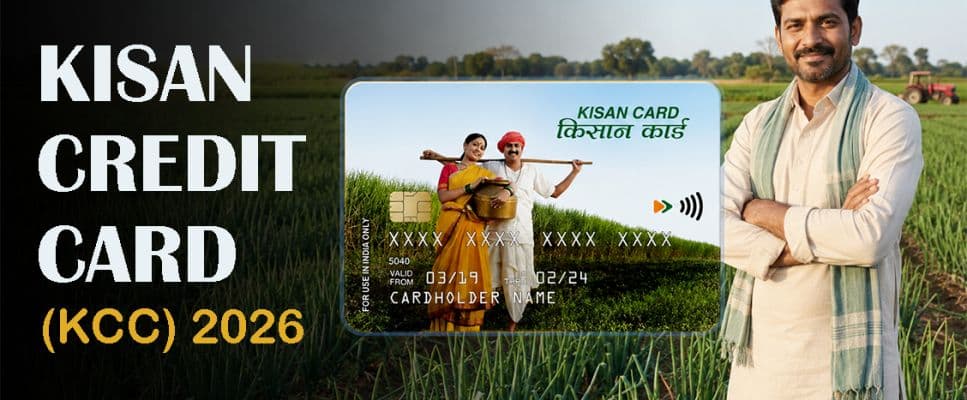
Kisan Credit Card (KCC) also widely known as Kisan Card is a government-backed credit scheme that offers farmers easy access to short-term and long-term loans for farming, agricultural investments, and allied activities, helping improve productivity and income.
Key Takeaways — Kisan Credit Card 2026
Benefits: Provides crop loans, working capital, post-harvest credit, and investment credit for agriculture and allied activities.
Loan interest rate: 7% p.a. (effective rate can be as low as 4% with eligible benefits).
Kisan Credit Card tenure: 5 years.
Kisan Credit Card limit: Based on land holdings, crops grown, allied activities, and credit requirements.
Collateral-free loan: Up to ₹2 lakh.
Application process: Through bank website/app, CSC centre, bank branch, or by downloading the KCC form from the PM Kisan portal.
What is Kisan Credit Card (KCC)?
The Kisan Credit Card (KCC) Scheme was launched in 1998 by the Government of India to provide adequate and timely credit to farmers for their agricultural operations. Under this scheme, KCCs are issued to farmers based on their landholdings and crop cultivation patterns, enabling them to purchase essential inputs such as seeds, fertilisers, and pesticides, as well as withdraw cash for production needs. To make farm credit affordable, the government provides an interest subvention of 2% and a Prompt Repayment Incentive of 3%, bringing the effective interest rate down to just 4% per annum.
Initially focused on crop production, the scheme was expanded in 2004 to cover allied and non-farm activities. The Interest Subvention Scheme (ISS), introduced in 2006-07, capped KCC loan interest at 7%. In Budget 2025-26, the Modified Interest Subvention Scheme (MISS) was announced, offering 7% interest on short-term agriculture loans up to ₹5 lakh through KCC, covering activities such as dairy farming, animal husbandry, and fisheries.
Kisan cards are issued by a wide range of financial institutions, including Public Sector Banks, Private Sector Scheduled Commercial Banks, Small Finance Banks, Regional Rural Banks (RRBs), Rural Cooperative Banks, and Primary Agricultural Credit Societies (PACS) linked with Scheduled Commercial Banks.
Did You Know? Kisan Credit Card is issued by 457 banks across India, including SBI, PNB, HDFC, Bank of Baroda, Canara Bank, and Regional Rural Banks.
Objective of the KCC Scheme
The main objective of the Kisan Credit Card scheme is to provide farmers with timely, affordable, and adequate credit support through a simplified single-window system. Specific objectives include:
- Meeting short-term credit needs for crop cultivation.
- Covering post-harvest expenses.
- Providing working capital for farm maintenance.
- Supporting allied activities like dairy and fisheries.
- Reducing farmer dependence on private moneylenders.
- Encouraging financial inclusion in rural areas.
- Offering produce marketing loans to help farmers sell their harvest.
- Meeting consumption needs of the farmer's household.
- Providing investment credit for agriculture and allied activities.
Types of Kisan Credit Card Scheme
Banks issue Kisan Card in different card formats based on technology and security. Here are the main types of Kisan Credit Card available to farmers:
- Magnetic Stripe Card with PIN: A standard card with a Personal Identification Number (PIN) and ISO IIN standard. It can be used at any bank ATM or micro ATM.
- Biometric KCC with Aadhaar Authentication: A card linked with UIDAI biometric verification. Farmers can authenticate transactions using their Aadhaar fingerprint instead of a PIN.
- Debit Card with Magnetic Stripe and Biometric Option: Combines magnetic stripe technology with biometric verification, giving farmers two ways to access their funds securely.
- EMV Chip Card (RuPay, MasterCard, or Visa): A chip-based card issued under RuPay, MasterCard, or Visa networks. It offers better security and works across all integrated payment systems.
- Smart Card-cum-Debit Card: Built on common open standards set by IDRBT and IBA. It allows farmers to transact directly with input dealers and receive payments at mandis or procurement centres.
Note: All new KCCs and renewed KCCs are now issued only as Smart Card-cum-Debit Cards, as per the latest RBI and NABARD guidelines.
Kisan Credit Card Delivery Channels
The following delivery channels are available for the farmers to use Kisan Card and transact their operations in their KCC account:
- Withdrawal through ATMs or Micro ATM
- Withdrawal through Business Correspondents (BCs) using smart cards
- PoS machine through input dealers
- Mobile Banking with IMPS capabilities or IVR
- Aadhaar-enabled cards

Benefits of Kisan Credit Card
The Kisan Credit Card scheme comes with a wide range of benefits that make farming easier and financially safer for Indian farmers. Here are the key kisan credit card benefits you should know:
- First-Year Credit Limit: Calculated based on the scale of finance, cultivated area, post-harvest and household expenses, farm asset maintenance, and insurance requirements.
- Annual Increase: The KCC loan limit is increased by 10% every year from the 2nd to 5th year to cover rising cultivation costs.
- Multiple Crops: For farmers growing more than one crop across Kisan Credit Card crop seasons (Kharif, Rabi, and Zaid), the limit is fixed according to the proposed cropping pattern and may be revised if the cropping pattern changes.
- Term Loan Facility: Additional loans can be provided for land development, irrigation, farm machinery, and allied agricultural activities.
- Long-Term Credit Limit: Based on proposed investments over five years and the farmer's repayment capacity.
- Maximum Permissible Limit (MPL): The total KCC limit is the sum of the 5th-year short-term credit requirement and the estimated long-term loan requirement.
- Separate Sub-Limits: Banks may maintain separate limits for short-term crop loans and term loans due to different interest rates and repayment schedules.
- Flexible Drawing Limit: Farmers can withdraw funds as per their crop production, maintenance, and consumption needs within the approved limit.
- Limit Revision: Banks may revise the drawable limit if the district's scale of finance increases beyond the assumed annual 10% escalation.
- Term Loan Withdrawals: Long-term loan amounts are released in installments based on the investment purpose and repayment schedule.
KCC Loan Limit & Interest Rate 2026
The Kisan Credit Card scheme offers one of the lowest interest rates available to farmers in India. Below is the updated KCC loan limit 2026 and interest rate structure:
|
Particulars
|
Details
|
|
Base Interest Rate
|
7% per annum
|
|
Interest Subvention (Govt of India)
|
3% (for loans up to ₹5 lakh)
|
|
Prompt Repayment Incentive (PRI)
|
Additional 3% benefit
|
|
Effective Rate (with timely repayment)
|
4% per annum
|
|
Maximum Loan Limit Under MISS
|
₹5 lakh (raised from ₹3 lakh)
|
|
Collateral-Free Loan Limit
|
₹2 lakh per borrower
|
|
Loan Validity
|
5 years (with annual review)
|
KCC Eligibility Criteria 2026
To apply for the Kisan Credit Card scheme, you must meet the following kisan credit card eligibility:
Who Can Apply (KCC Eligibility Criteria)
- Individual farmers who own cultivable land
- Joint cultivators and joint farmers
- Tenant farmers, sharecroppers, and oral lessees (with valid documents)
- Self Help Groups (SHGs) of farmers
- Joint Liability Groups (JLGs)
- Farmers engaged in allied activities — dairy, fisheries, poultry, animal husbandry
- PM Kisan beneficiaries (auto-eligible from 2026)
Age Requirement
- Minimum age: 18 years
- Maximum age: 75 years
- For applicants above 60 years, a co-borrower (legal heir) is required
Documents Required for Kisan Credit Card Scheme
Keep these documents ready before applying for Kisan Credit Card Scheme:
- Application Form.
- Two Passport Size Photographs.
- ID proof such as Driving License / Aadhar Card / Voter Identity Card / Passport.
- Address Proof such as Driving License, Aadhar Card.
- Proof of landholding duly certified by the revenue authorities.
- Cropping pattern (Crops grown) with acreage.
- Security documents for loan limit above Rs.1.60 lakhs / Rs.3.00 lakhs, as applicable.
- Any other document as per sanction.

How to Apply for Kisan Credit Card Online
You can complete your Kisan Card application in following ways.
1. Online via Jan Samarth Portal (Fastest — PM Kisan Credit Card Online Apply with Aadhaar Card)
Visit Jansamarth Portal, check your eligibility, fill in your land and crop details, and upload the required documents. The portal routes your application directly to your chosen bank's loan processing system. With Aadhaar-based e-KYC under the d-KCC (Digital KCC) initiative, you can get faster approvals without visiting a bank branch.
2. Online via PM Kisan Portal
Visit PM-Kisan, click on "Kisan Credit Card (KCC)" under the Quick Links section, and download the KCC application form. Fill it out and submit it to your nearest bank branch. This method works best if you are already a PM Kisan beneficiary.
3. Online via Your Bank's Website or App
Most major banks have dedicated Kisan card application sections. SBI allows applications through the YONO app, PNB through PNB ONE, and other banks like HDFC and Bank of Baroda offer KCC sections on their websites. Log in, navigate to agricultural loans, and follow the steps to apply.
4. Through CSC (Common Service Centre)
Visit your nearest Common Service Centre with your documents and let the operator complete the application on your behalf for a small service fee. This is a good option if you are not comfortable applying online yourself.
5. Offline at a Bank Branch
Walk into any nationalised bank, Regional Rural Bank (RRB), or cooperative bank where you hold an account. Collect the KCC application form from the agricultural loans counter, fill it in, attach all required documents, and submit it to the loan officer.
Once submitted, your application will be reviewed within 7 to 14 working days. You can track your application status online through the Jan Samarth portal or the Kisan Rin Portal 2.0 for real-time updates on your KCC approval and subvention credits.
KCC Status Check - Aadhaar Card & Mobile Number
After submitting your Kisan card application, you can check its status online using your Aadhaar card or registered mobile number.
Quick Steps for KCC Status Check
- Visit your bank's official portal (e.g., onlinesbi.sbi, pnbindia.in)
- Log in with your customer ID or registered mobile number
- Go to "Loan Status" or "Application Status"
- Enter your KCC application reference number
- Your current status will appear — Pending, Under Review, Approved, or Rejected
KCC Helpline Number & Support
If you face any issue with your Kisan Credit Card application or operation:
PM Kisan Helpline (For KCC Linked to PM Kisan)
- Toll-Free: 1800-115-526
- Main Helpline: 155261
- Landline: 011-24300606
- Email: pmkisan-ict@gov.in
Bank-Specific KCC Helplines
- SBI: 1800-1234 / 1800-2100
- PNB: 1800-180-2222
- HDFC Bank: 1800-202-6161
- Bank of Baroda: 1800-258-44-55
- Canara Bank: 1800-425-0018
Similar Article:
PM Kisan Samman Nidhi Yojana (PM-KISAN)
PM Fasal Bima Yojana (PMFBY)
Soil Health Card Scheme 2026