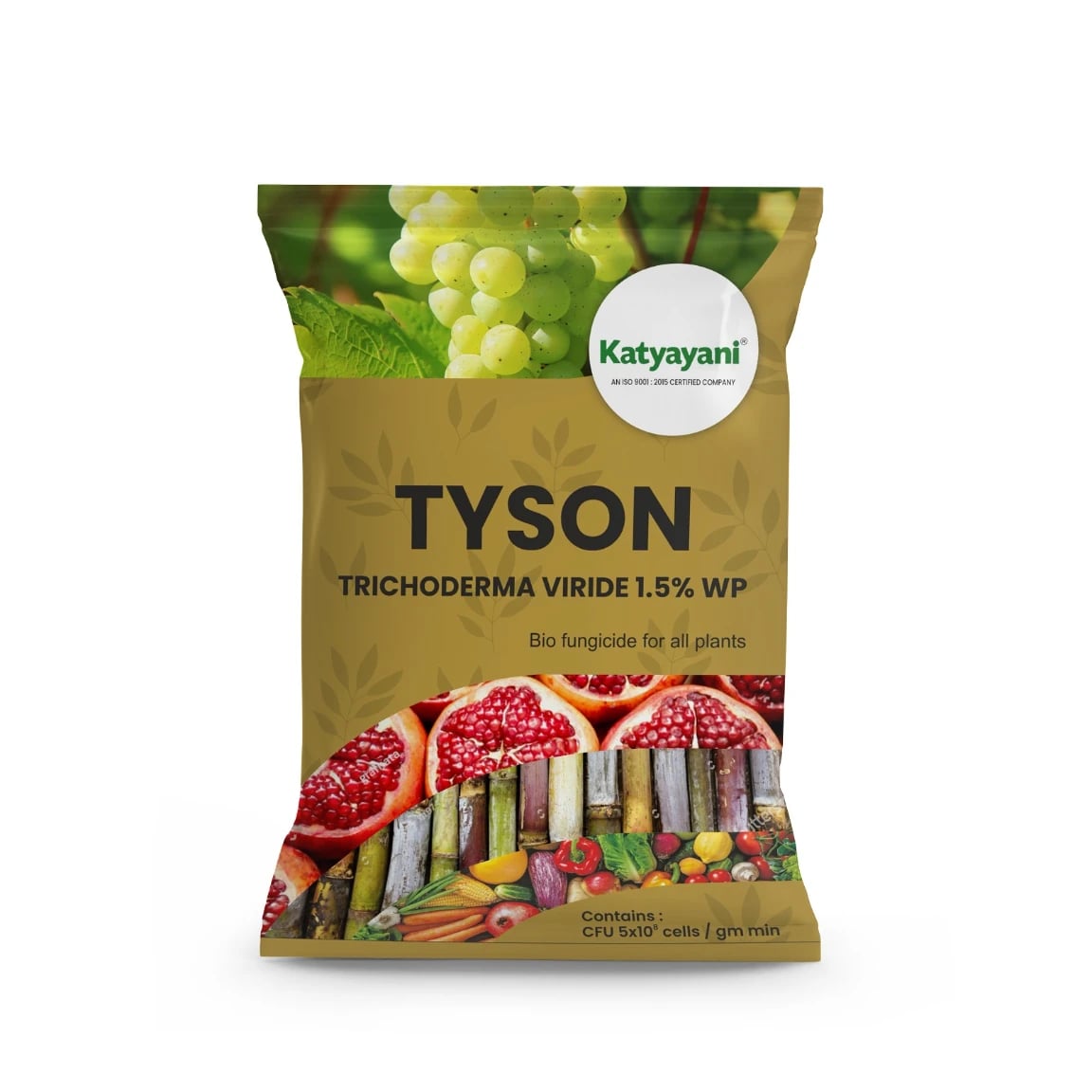
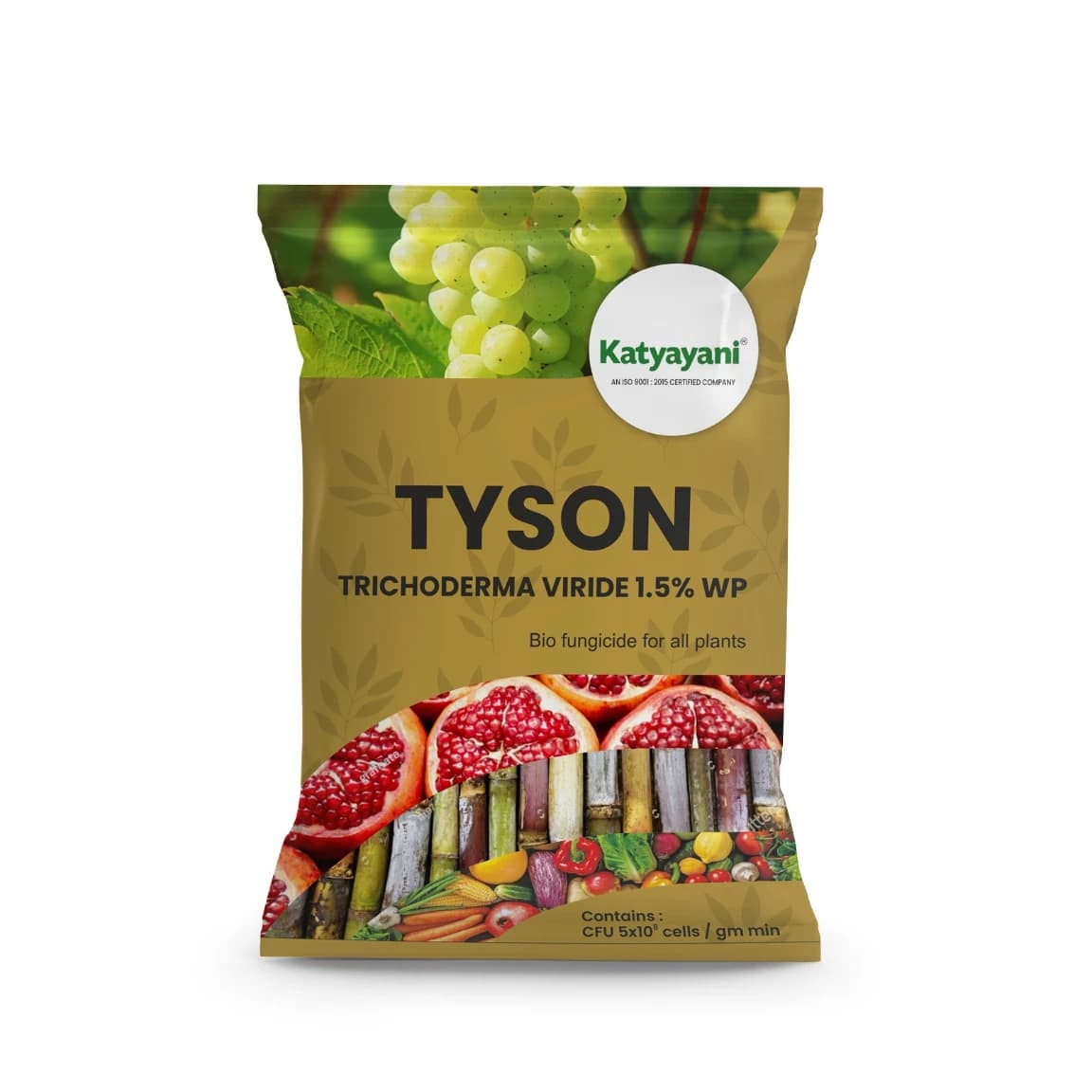
Dr. Bacto's Dermus 4K Biological Fungicide - Made From The Mycoparasitic Fungus, Protect Crops From Soil-Borne & Seed Borne Diseases
₹2169₹2608
Save ₹43917% Off
🎉 You Save ₹587 (49% OFF)
Buying In Bulk?
Get Special Pricing for large orders, contact us now!


| Brand: | Katyayani Organics |
| Product Code: | 11544 |
| Country of Origin: | India |
| Category: | Crop Protection |
| Sub Category: | Bio Pesticides |
| Sub Sub Category: | Bio Fungicide |




Katyayani Tyson is a biological fungicide containing Trichoderma Viride 1.5% WP (Wettable Powder), formulated to help manage various soil-borne fungal diseases in crops. It helps control diseases such as wilt, root rot, blight, damping-off and other fungal infections by suppressing harmful fungi and supporting healthier root development. Katyayani Tyson is suitable for soil application, seed treatment, nursery use and other recommended agricultural applications to support crop health and soil protection.
Technical Content: Trichoderma Viride 1.5% WP
Formulation: Wettable Powder (WP)
Mode of Entry: Contact
Mode of Action: Preventive & Curative
Broad-Spectrum Protection: Helps manage various soil-borne fungal diseases, including wilt, root rot, damping-off and blight.
Fungal Growth Suppression: Helps suppress harmful fungal growth and sporulation through biological activity.
Supports Root Growth: Promotes healthy root development and overall plant vigor.
Soil Health Support: Supports beneficial microbial activity and soil health.
Versatile Application: Suitable for foliar spray, soil drenching, seed treatment, seedling dip and nursery application.
Crop Protection: Helps protect crops against soil-borne fungal infections when used as recommended.
Phytotoxicity: No reported phytotoxic effects when used as per recommended dosage.
Katyayani Tyson Trichoderma Viride 1.5% WP is recommended for chilli, pulses, paddy, tomato, cabbage, brinjal, cauliflower, sunflower and Bengal gram crops.
It helps manage soil-borne fungal diseases such as wilt, root rot, damping-off, sheath blight, stalk rot, collar rot, seedling wilt and seed rot.
Application Method | Recommended Dosage | Application Instructions |
Foliar Spray | 5–10 g per litre of water | Dissolve in water and spray on both sides of leaves during evening hours. |
Soil Drenching | 1–2 kg per acre in 200 litres of water | Mix thoroughly and drench the soil. |
Seed Treatment | 8–10 g per kg of seed in 50 ml of water | Coat seeds uniformly, shade dry and sow. |
Seedling Dip | 500 g in 50 litres of water | Dip seedlings for 30 minutes and transplant immediately. |
Nursery Treatment | 500 g in 10 kg of well-decomposed manure per acre | Mix properly and broadcast in the nursery area. |
Horticulture Crops | 50–100 g per plant | Mix with compost and apply in the root zone. |
Foliar Application: Prepare the solution as per the recommended dosage and spray evenly on the crop during evening hours.
Soil Application: Mix the recommended quantity with water or compost and apply around the root zone.
Seed Treatment: Coat seeds uniformly with the recommended solution and shade dry before sowing.
Seedling Treatment: Dip seedlings in the prepared solution for 30 minutes before transplanting.
Nursery Application: Mix with well-decomposed manure and apply evenly to the nursery soil.
Store in a cool and dry place.
Keep away from direct sunlight.
Store in the original packaging in a dry environment.
Refer to the product label for usage instructions, dosage and safety precautions. Use only as recommended.
1. What is Katyayani Tyson used for?
Katyayani Tyson is a biological fungicide used to help manage soil-borne fungal diseases such as wilt, root rot, damping-off and other fungal infections in crops.
2. What is the active ingredient in Katyayani Tyson?
It contains Trichoderma Viride 1.5% WP (Wettable Powder), a beneficial microorganism used for biological disease management.
3. Which crops can be treated with Katyayani Tyson?
It is recommended for chilli, pulses, paddy, tomato, cabbage, brinjal, cauliflower, sunflower and Bengal gram.
4. Which diseases does Katyayani Tyson help control?
It helps manage wilt, root rot, damping-off, sheath blight, stalk rot, collar rot, seedling wilt and seed rot.
5. How much Katyayani Tyson is required per acre?
For soil drenching, the recommended dosage is 1–2 kg per acre mixed in 200 litres of water