Weeds are the biggest hidden enemy of every Indian farmer. They steal up to 30–50% of your crop yield by competing with the main crop for water, sunlight, and nutrients. In a country like India, where farms are small and labour is becoming expensive every year, manual weeding alone is no longer enough to keep fields clean. This is where modern herbicides for weed control come in as a fast, affordable, and effective solution.
Whether you grow paddy in West Bengal, wheat in Punjab, cotton in Gujarat, or vegetables in Maharashtra, the right herbicide can save you thousands of rupees and protect your yield. But with hundreds of products in the market, choosing the correct one for your crop and weed problem is confusing for most farmers.
In this guide, we'll go through the top herbicides used in India — their uses, application timing, target weeds, and the crops they suit best.
What Are Herbicides and Why Do Indian Farmers Need Them?
A herbicide is a chemical product used in agriculture to kill, control, or stop the growth of unwanted plants called weeds, without damaging the main crop. Herbicides are also commonly called weedicides in Indian farming language. They are sprayed on the field either before the crop comes up (pre-emergence) or after it has started growing (post-emergence).
Indian farmers are switching to herbicides for three big reasons:
- Labour shortage: Manual weeding now costs ₹3,000–₹5,000 per acre. A herbicide spray does the same job in ₹500–₹1,200 per acre.
- Time saving: One spray covers 1 acre in 1–2 hours. Manual weeding takes 8–12 labour days.
- Better yield: Timely weed control gives 15–35% higher yield compared to weedy fields.
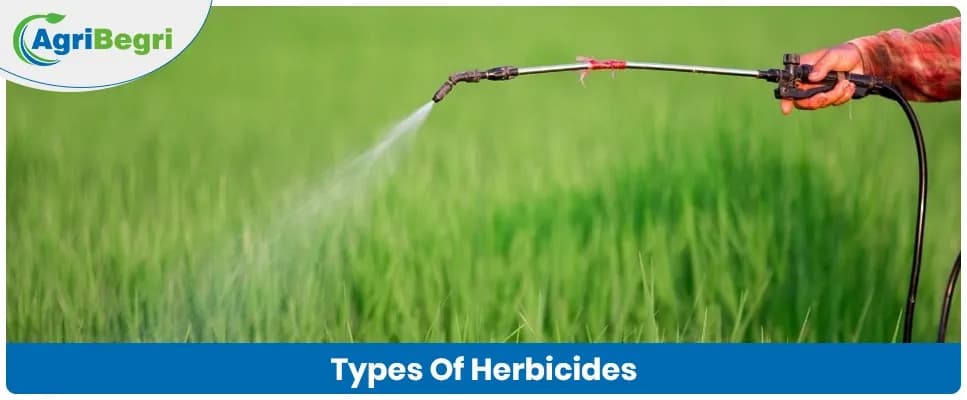
Types of Herbicides for Weed Control
There are many herbicides available, and each one works differently. Understanding them helps you pick the right product for your field that gives better weed control while keeping the crop safe.
- Selective vs Non-Selective: Selective herbicides only target weeds and keep your crop safe. Non-selective ones kill everything green, including your crop, so they are used only on empty fields or before sowing.
- Pre-Emergence vs Post-Emergence: Pre-emergence herbicides are applied within 0 to 3 days of sowing, before the weeds appear. Post-emergence ones are applied later, once the weeds have already grown.
- Contact vs Systemic: Contact herbicides kill only the part of the weed they touch. Results are fast, but the weed can grow back. Systemic insecticides move inside the plant and kill it from the roots, preventing regrowth.
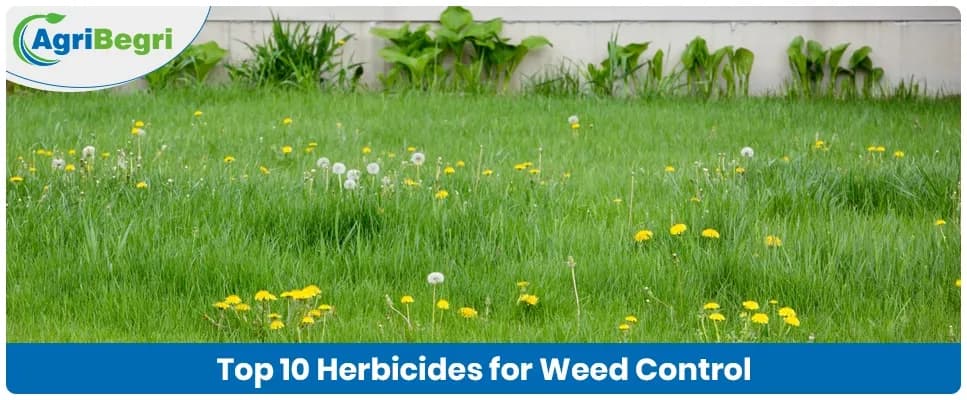
Top 10 Herbicides for Weed Control
Given below are ten herbicides commonly used for weed control across India.This list of popular herbicides in India covers almost every major crop grown across the country.
1. Pendimethalin 38.7% CS (Selective Pre-Emergent Herbicide)
Pendimethalin 38.7% CS is one of the most widely used pre-emergence herbicides in India. The CS (Capsule Suspension) formulation forms a long-lasting protective layer in the soil that stops weeds from germinating. It also drifts less during spraying, making it safer for nearby crops than the older EC formulations.
- Best for: Wheat, paddy, pulses, soybean, cotton, onion, garlic, chilli
- Target weeds: Broadleaf weeds and annual grasses
- Application time: Within 0–3 days after sowing or transplanting, on moist soil
- Important note: Highly compatible with zero-tillage and reduced-tillage farming. Apply on moist soil for best results. The yellow stain on clothes is normal — wear old clothes.
2. Imazethapyr 10% SL (Selective Post-Emergent Herbicide)
Imazethapyr 10% SL is one of the best post-emergence herbicides for pulse and oilseed crops in India. It enters the weed through both leaves and roots, which makes it very effective even after weeds have already started growing.
- Best for: Soybean, groundnut, pulses (gram, moong, urad, arhar)
- Target weeds: Broadleaf weeds and grassy weeds
- Application time: 15–20 days after sowing, when weeds are at 2–4 leaf stage
3. Bispyribac Sodium 10% SC (Selective Post-Emergent Herbicide)
Bispyribac Sodium 10% SC is one of the top herbicides in India for paddy. It is highly effective in all types of rice cultivation — both transplanted paddy (TPR) and direct-seeded rice (DSR).
- Best for: Direct-seeded rice (DSR), transplanted paddy (TPR)
- Target weeds: Grasses (Echinochloa), sedges, and broadleaf weeds
- Application time: 10–15 days after sowing/transplanting (weeds at 2–4 leaf stage)
- Important note: Drain field water before spraying. Re-irrigate 24–48 hours after spray for best results. Excellent crop safety on rice.
4. Quizalofop Ethyl 5% EC (Selective Systemic Herbicide)
Quizalofop Ethyl 5% EC is a powerful grass killer that is absorbed through the leaves and moves systemically inside the weed, stopping growth from within by blocking key enzymes. It is one of the most popular herbicides in India for grassy weed problems in broadleaf crops.
- Best for: Soybean, groundnut, cotton, onion, vegetables
- Target weeds: Annual and perennial grassy weeds only (no effect on broadleaf weeds)
- Application time: When grassy weeds are at 3–5 leaf stage (post-emergence)
- Important note: Works only on grasses, not on broadleaf weeds. For mixed weed flora, tank-mix or combine with a broadleaf herbicide as per label.
5. Metribuzin 70% WP (Selective Systemic & Contact Herbicide)
Metribuzin 70% WP is a flexible herbicide that acts as both contact and systemic, making it very effective on early-stage weeds. It is one of the most useful herbicides for weed control in multiple crops.
- Best for: Soybean, sugarcane, potato, wheat, tomato
- Target weeds: Broadleaf weeds and some annual grasses
- Application time: Pre-emergence (within 3 days of sowing) or early post-emergence (15–20 DAS)
6. Glyphosate 71% SG (Non-Selective Herbicide)
Glyphosate 71% SG is a non-selective herbicide for weed control that gives total control over all green vegetation. It is one of the most powerful herbicides in the world and a top choice for bund farming, plantations, and pre-sowing land preparation.
- Best for: Tea plantations, non-crop areas, bunds, before sowing of crops
- Target weeds: All annual and perennial weeds — grasses, broadleaf, sedges
- Application time: When weeds are 4–6 inches tall and actively growing
7. Ammonium Salt of Glyphosate 71% SG (Non-Selective Systemic Herbicide)
Ammonium Salt of Glyphosate 71% SG is a specific salt formulation of glyphosate that is more stable in storage and provides excellent systemic action. It enters the plant through the leaves and travels down to the roots, killing both annual and perennial weeds completely.
- Best for: Orchard interspaces, plantation crops, non-crop areas, before sowing
- Target weeds: All annual and perennial weeds, including tough perennial weeds like Cynodon (doob grass) and Cyperus rotundus (motha)
- Application time: When weeds are 4–6 inches tall, on a bright sunny day for best absorption
8. Paraquat Dichloride 24% SL (Non-Selective Contact Herbicide)
Paraquat Dichloride 24% SL is a fast-acting, non-selective contact herbicide. Within 24–48 hours of spraying, weeds turn brown and dry up. It is the go-to agricultural weed control solution for drylands and inter-row weed clearing.
- Best for: Tea, coffee, rubber, oil palm, potato, maize (directed spray only), pre-sowing land preparation
- Target weeds: All green weeds (above-ground parts only)
- Application time: When weeds are young and actively growing
9. 2,4-D Amine Salt 58% SL (Selective Post-Emergent Herbicide)
2,4-D Amine Salt 58% SL is one of the oldest and most trusted herbicides in India for broadleaf weed control in cereal crops. It maintains clean crop rows and supports uniform plant growth in wheat, paddy, and sugarcane.
- Best for: Wheat, paddy, sugarcane, maize, sorghum
- Target weeds: Broadleaf weeds — Chenopodium (bathua), Convolvulus (hirankhuri), Anagallis (krishnanil)
- Application time: 25–35 days after sowing, during mid-crop stage when broadleaf weeds appear
10. Fenoxaprop-p-ethyl 6.9% EC (Selective Post-Emergent Herbicide)
Fenoxaprop-p-ethyl 6.9% EC is one of the top herbicides in India for grassy weed control in rice and wheat. It provides excellent selectivity without affecting the crop yield and is mostly used during the early tillering stage of crop growth.
- Best for: Rice and wheat (selective grass control)
- Target weeds: Grassy weeds — Phalaris minor (gulli danda), wild oats in wheat; Echinochloa in rice
- Application time: 25–35 days after sowing, at the early tillering stage of the crop
How to Use Herbicides for Weed Control Safely
Using herbicides correctly is just as important as choosing the right one. The wrong technique can damage your crop, harm your health, or waste your money. Follow these simple steps.
Pre-Spray Checklist
- Read the product label carefully and check the expiry date
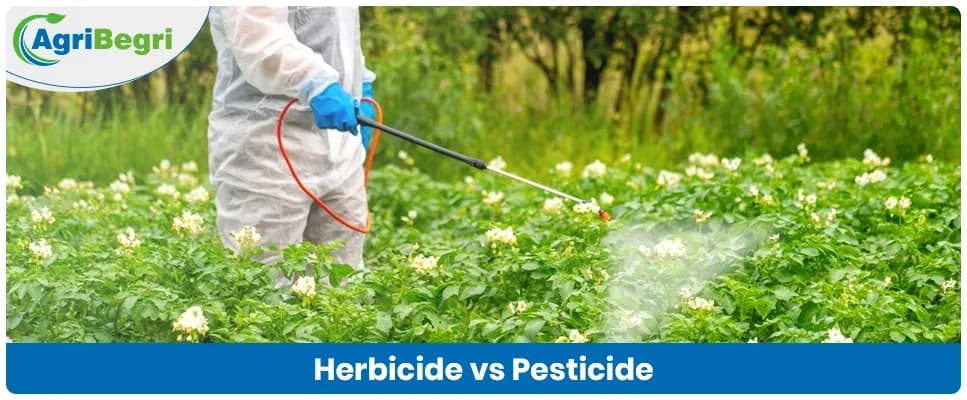
- Wear gloves, mask, full-sleeve shirt, full pants, and shoes
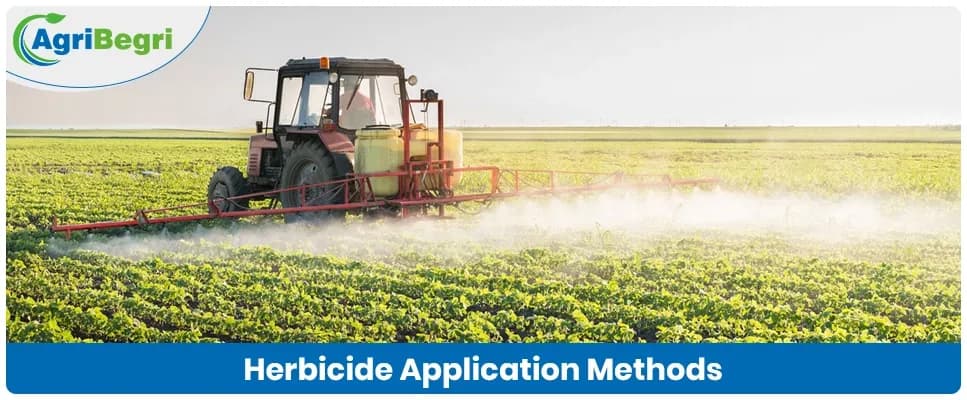
- Calibrate your sprayer — usually 200 litres of water per acre
- Spray only in calm weather (no strong wind)
- Avoid spraying just before or right after rain
Correct Spray Technique
- Use a flat-fan nozzle for herbicides (not hollow cone — that is for insecticides)
- Spray in early morning (6–10 AM) or evening (4–6 PM)
- Maintain uniform walking speed and nozzle height (about 18 inches above ground)
- Do not mix herbicide with insecticide unless the label clearly allows it
- Wash sprayer 3 times with clean water after use
Safety Precautions
- Never eat, drink, smoke, or chew tobacco during spraying
- Take a full bath and change clothes immediately after work
- Keep children, pregnant women, and animals away from the sprayed field for 24 hours
- Store herbicides in a locked place, away from food and animal feed
Best Practices for Maximum Weed Control
For long-term and effective weed management, follow these expert tips:
- Rotate herbicides: Don't use the same herbicide every season — weeds develop resistance (especially Phalaris minor in wheat).
- Integrate methods: Combine herbicide use with hand weeding, mulching, and crop rotation for best results.
- Identify the weed first: Match the herbicide to the weed type — grass, broadleaf, or sedge.
- Maintain field hygiene: Clean bunds, channels, and field borders so weed seeds don't spread.
- Use the stale seedbed method: Irrigate the field, let weeds germinate, kill them with a non-selective herbicide, then sow your crop.
- Keep records: Note down which herbicide you used, when, and the result. This helps in next season's planning.
Conclusion
Weeds will always be a part of farming, but with the right knowledge and tools, you can keep them under control without losing yield or money. A suitable herbicide product applied at the correct stage keeps your fields clean and your crop healthy.
Before you spray, keep three things in mind: right product, right dose, right time. Start with a small trial on a part of your field, observe the results, and then scale up. Consult your local agriculture officer or input dealer for region-specific recommendations, and always read the product label carefully before every use.