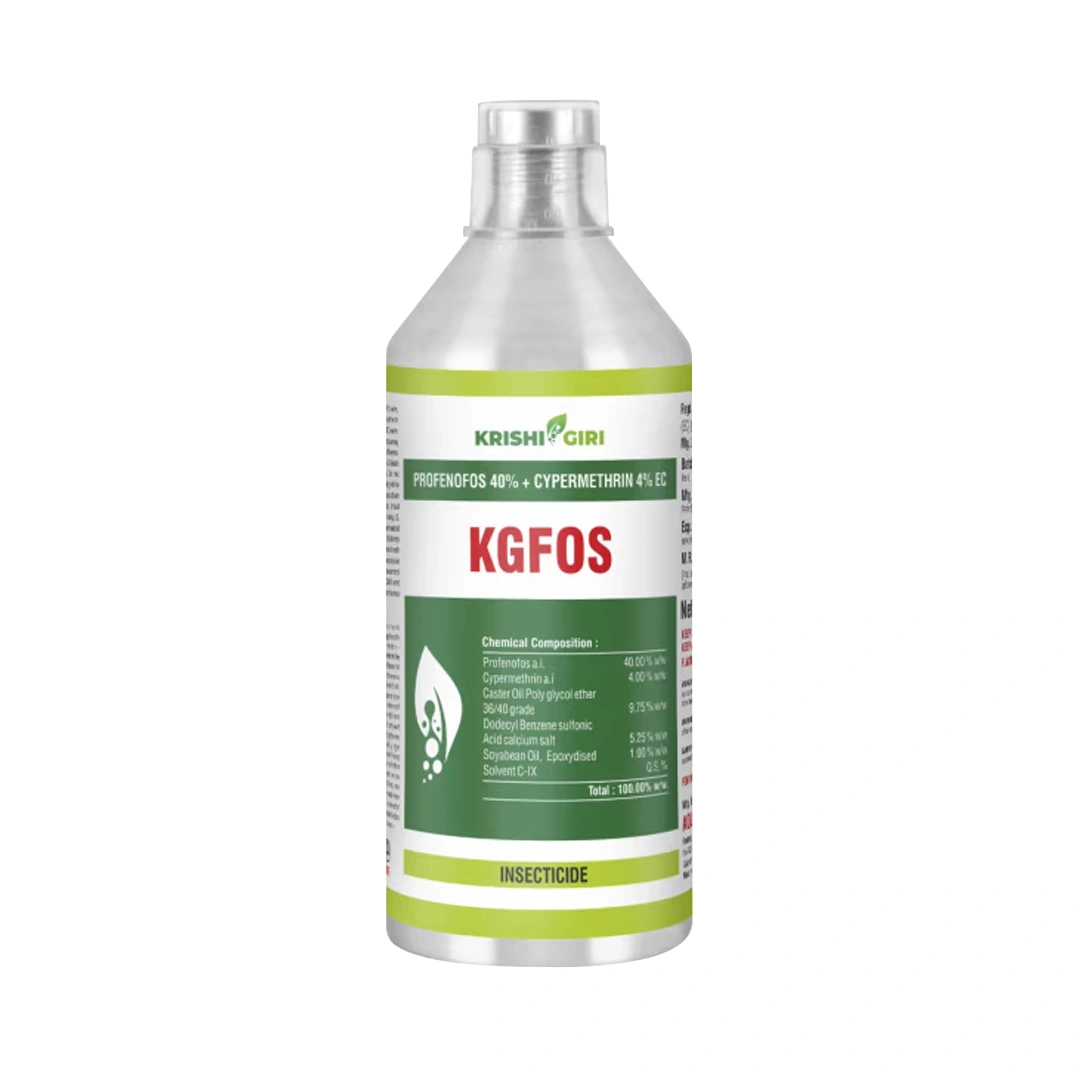
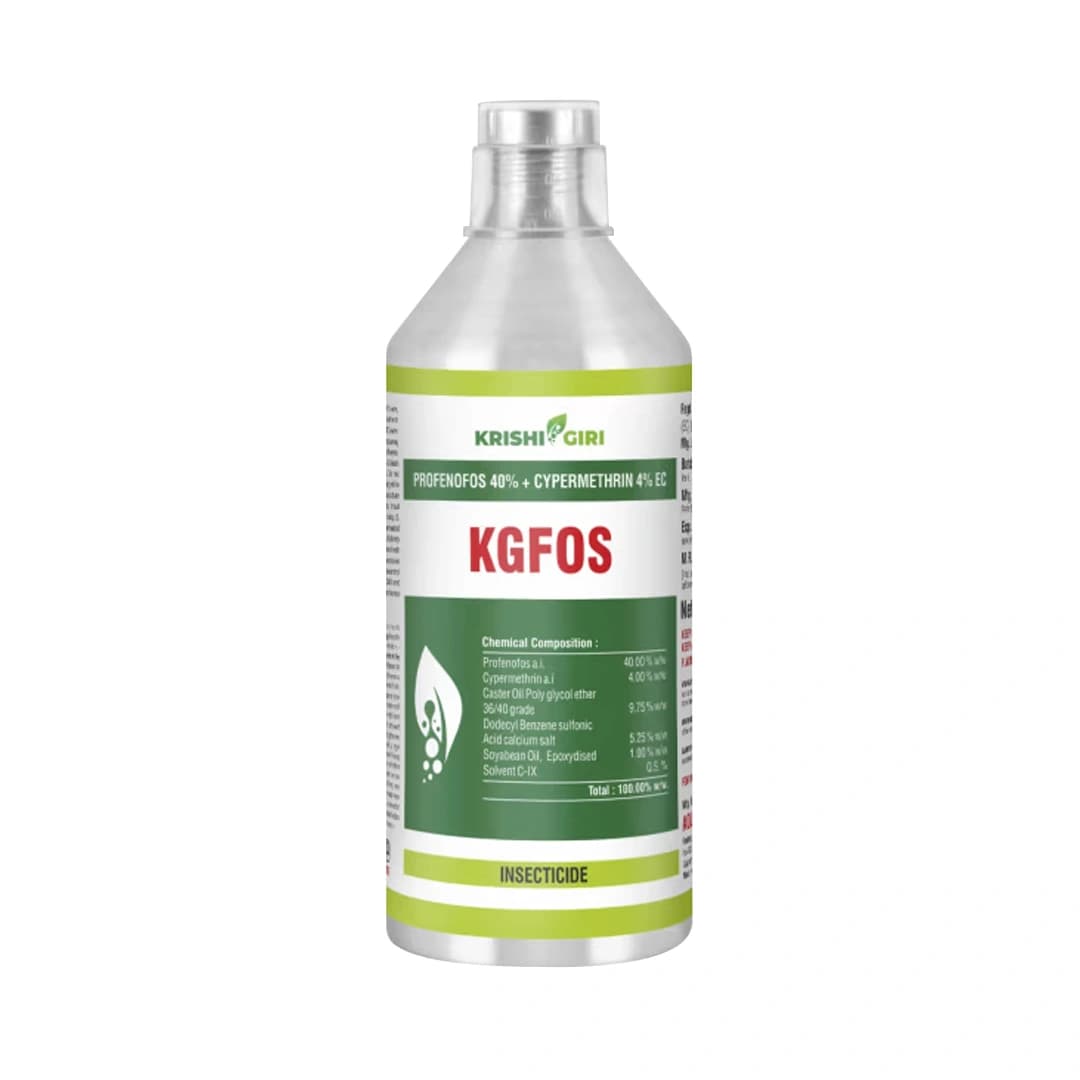
Krishigiri KGFOS is a broad-spectrum insecticide containing Profenofos 40% + Cypermethrin 4% EC, a field-proven combination that targets bollworms, caterpillars, aphids, thrips, and mites across multiple crops. The dual-action formula kills pests through both contact and stomach action, delivering fast knockdown along with residual protection that protects crops for a longer period. Available in multiple pack sizes, Krishigiri KGFOS is a go-to solution for farmers looking to tackle both bollworms and sucking pests on cotton and vegetable crops.
Key Features & Benefits Of Krishigiri KGFOS:
Dual Action: Profenofos 40% + Cypermethrin 4% EC targets pests through contact and stomach action, and reduces their population.
Fast Knockdown: Cypermethrin acts within minutes of spraying, stopping pest feeding and preventing further crop damage instantly.
Ovicidal Activity: Profenofos 40% + Cypermethrin 4% EC destroys pest eggs along with larvae and adults, breaking the pest life cycle at every stage.
Translaminar Action: Penetrates leaf tissue to reach pests hiding under the leaves and provides uniform coverage.
Acaricidal Properties: KGFOS insecticide is effective against mites, handling both insects and mite infestations simultaneously.
Long Residual: It provides sustained residual protection after spraying, reducing the frequency of repeat applications.
Rainfast Formula: Profenofos 40% + Cypermethrin 4% EC remains effective even after light rainfall, making it useful for various field conditions.
Wide Crop Coverage: Profenofos 40% + Cypermethrin 4% EC is suitable for Cotton and widely used across Vegetable crops, including Cabbage, Okra, and Tomato.
Target Pests— What Does KGFOS Control?
Bollworms & Caterpillars: American Bollworm, Pink Bollworm, Spotted Bollworm, Fruit-boring Caterpillars, Spodoptera
Sucking Insects: Aphids, Thrips, Whiteflies, Jassids, Leafhoppers
Mites: Spider Mites, Red Mites
Other Pests: Diamond Back Moth, Leaf Roller, Cutworms
Profenofos 40% + Cypermethrin 4% EC Dose — Crop Wise Recommended Dose:
Mix Krishigiri KGFOS in 200 litres of water per acre for foliar spray. Apply Profenofos 40% + Cypermethrin 4% EC at the first sign of pest infestation for best results.
Crop | Target Pests | Dose/Acre | Per 15L Pump |
|---|
Cotton | Bollworm complex, aphids, thrips, whitefly | 400 to 500 ml | 30 to 38 ml |
Cabbage | Diamondback moth, caterpillars, aphids | 300 to 400 ml | 22 to 30 ml |
Okra | Fruit borer, thrips, jassids | 300 to 400 ml | 22 to 30 ml |
Tomato | Fruit borer, whiteflies, and mites | 300 to 400 ml | 22 to 30 ml |
Chilli | Fruit borer, thrips, mites | 300 to 400 ml | 22 to 30 ml |
Note: Do not exceed the recommended dose.
How To Use KGFOS — Application Instructions:
Shake the KGFOS bottle well before measuring the required dose.
Fill the sprayer halfway with clean water.
Add the measured quantity of KGFOS directly into the water.
Fill the sprayer with the remaining water and stir well until the mixture turns milky white.
Spray thoroughly on all plant parts, including the underside of leaves.
Best Time to Apply:
Spray Profenofos 40% + Cypermethrin 4% EC in the early morning or late evening when the weather is cool, and the wind speed is low.
Frequency of Application & Re-Entry Period:
Frequency of Application: Apply at the first sign of pest attack. Repeat after 10–15 days if pest pressure continues. Do not apply more than 2–3 times per season to avoid resistance build-up.
Re-Entry Period: Do not enter treated fields for at least 24–48 hours after spraying without proper protective gear.
Tank-mix Compatibility: Compatible with most fungicides and foliar fertilizers. Always do a jar test before mixing.
Safety Precautions & Handling:
Put on full protective clothing such as gloves, goggles, and a mask.
Do not eat, drink, or smoke at any time during mixing or spraying.
Thoroughly wash all exposed skin with soap and water right after use.
Keep children, pets, and livestock away from sprayed fields for 48 hours.
Toxic to bees — avoid spraying during flowering or active bee foraging hours.
Keep away from ponds, fish farms, rivers, and other water sources during application.
Triple rinse empty containers, puncture, and discard as per local waste guidelines.
Restricted in Kerala — not for sale or use in the State of Kerala.
Storage Instructions:
Keep it in a sealed container and a cool, dry, shaded area.
Store away from food items, animal feed, drinking water, and seeds.
Always keep out of reach of children and farm animals.
Storage Temperature: Below 35°C
Shelf Life: 2 years from the date of manufacture.
Product Specifications:
Product Name | Krishigiri KGFOS Insecticide |
Technical Name | Profenofos 40% + Cypermethrin 4% EC |
Formulation Type | Emulsifiable Concentrate (EC) |
Mode of Action | Contact + Stomach Poison |
Target Crops | Cotton, Vegetables |
Pack Sizes Available | 250 ml, 500 ml |
Country of Origin | India |
Shelf Life | 2 Years from the Date of Manufacture |
Restriction | Not For Sale Or Use In Kerala |
Frequently Asked Questions (FAQ) — Krishigiri KGFOS / Profenofos 40% + Cypermethrin 4% EC
What is Profenofos 40% + Cypermethrin 4% EC used for?
It controls Bollworm Complex, Caterpillars, Aphids, Thrips, Mites, and Whiteflies on Cotton and Vegetable crops.
For how long does Cypermethrin remain effective on crops?
Cypermethrin typically remains effective for 10–15 days after spraying under normal weather conditions. Repeat application may be needed if pest pressure continues after this period.
When to spray KGFOS insecticide?
Apply at the first sign of pest attack in the field. Early morning or late evening is the best time to spray when the weather is cool, and the wind speed is low.
Does rain wash away Profenofos 40% + Cypermethrin 4% EC?
KGFOS has a rainfast formula; once the spray dries on the plant, light to moderate rainfall does not wash it off. However, avoid spraying if heavy rain is expected within 2–3 hours of application for best results.
What is the best time to spray KGFOS?
Early morning or late evening, when the weather is cool and calm for better spray settling, reduced evaporation, and safer for honeybees in the field.