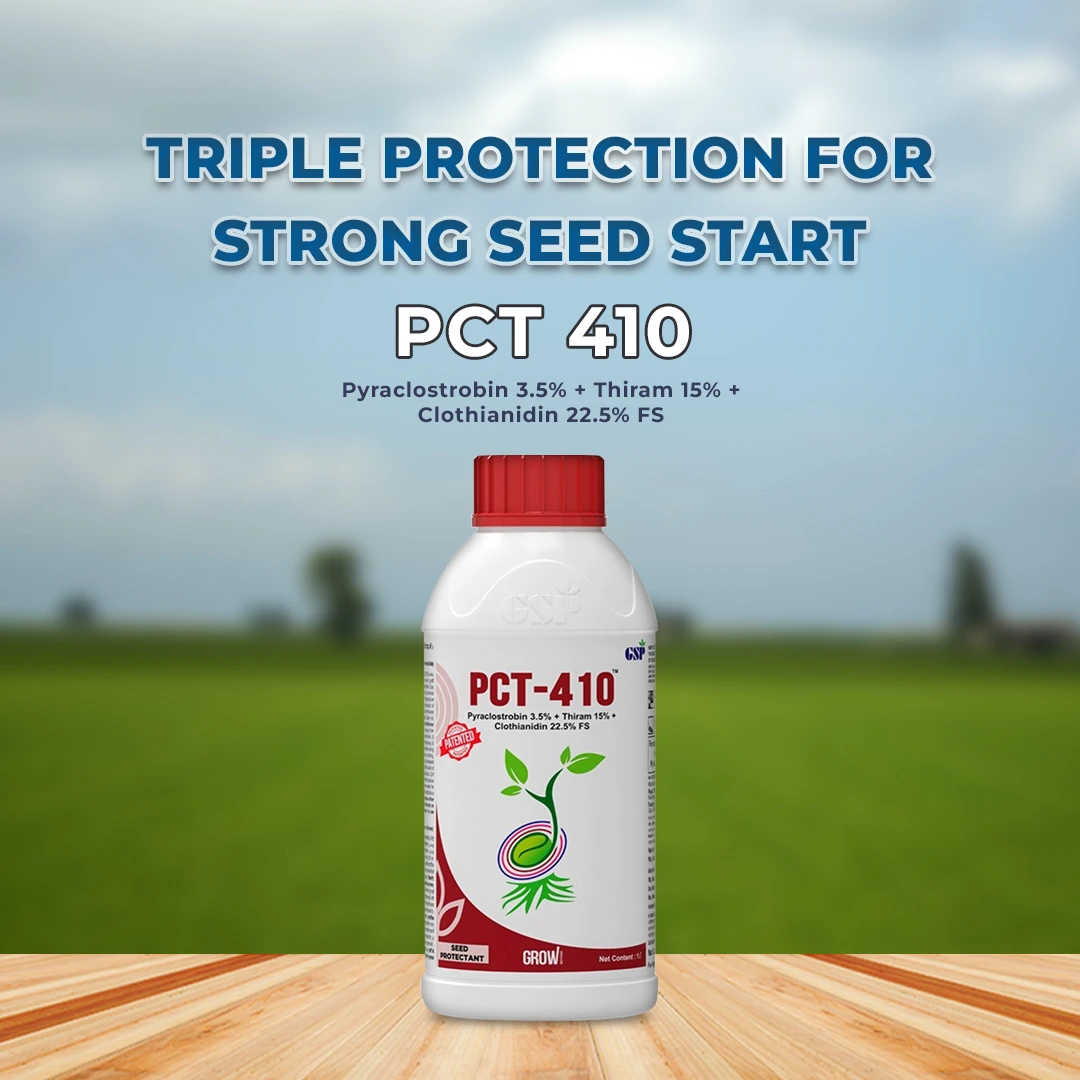
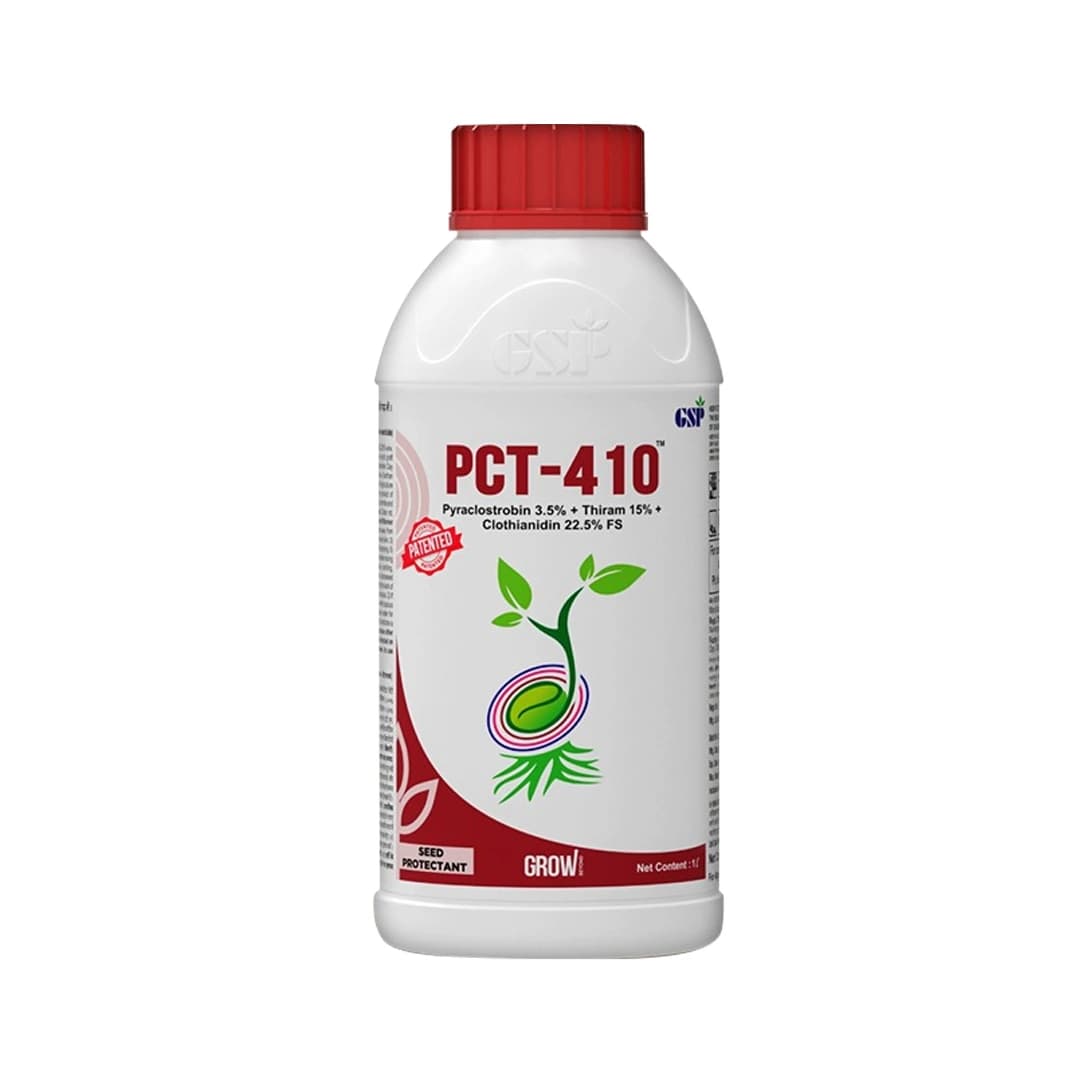
GSP PCT 410 is a seed-treatment product used to protect seeds and young seedlings from early fungal diseases and early sucking pest pressure. It contains a triple formula that offers both systemic and contact modes of action. It works by inhibiting mitochondrial respiration, preventing external fungal infections and spore germination, and is absorbed by the developing roots and translocated through the plant to protect seedlings. GSP PCT 410 helps improve seedling stand, root development, greening, and early crop vigour when seed treatment is done properly. This product also protects crops from pest attacks while controlling fungal diseases.
Key Features and Benefits of PCT 410 Fungicide:
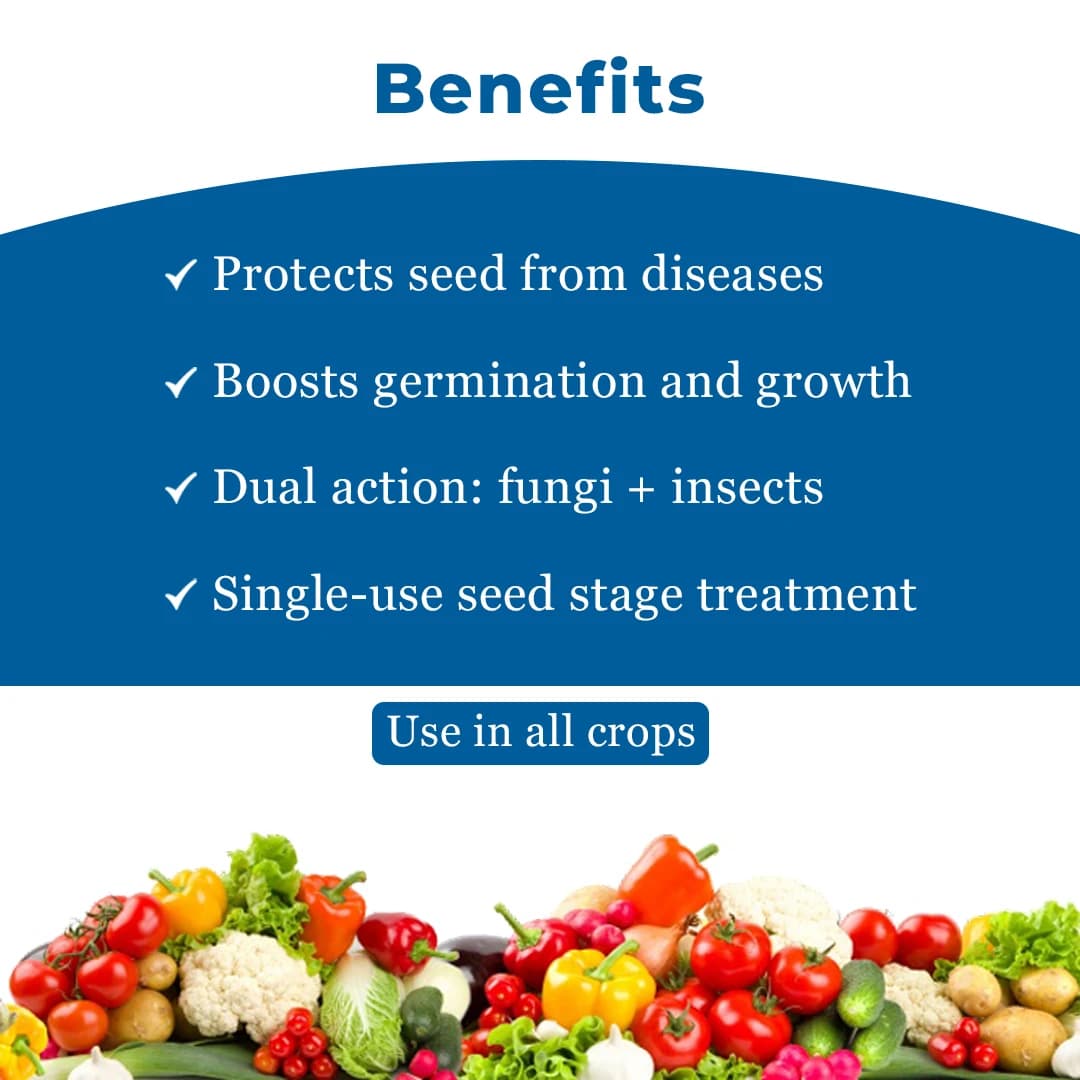
Seed Protection: GSP PCT 410 protects treated seed and young seedlings from early fungal disease pressure, ensuring healthy early growth.
Dual Action: PCT 410 can be used as a fungicide and an insecticide, providing broad-spectrum protection for the best results.
Root Growth Support: PCT 410 fungicide helps seedlings develop stronger roots, leading to improved crop growth and development.
Early Protection: The GSP PCT 410 contains Clothianidin, which supports early control of listed sucking and soil pests.
Useful Across Crops: This fungicide can be used in cereals, oilseeds, cotton, sunflower, soybean, and vegetable crops as per label guidance.
PCT 410 Uses:
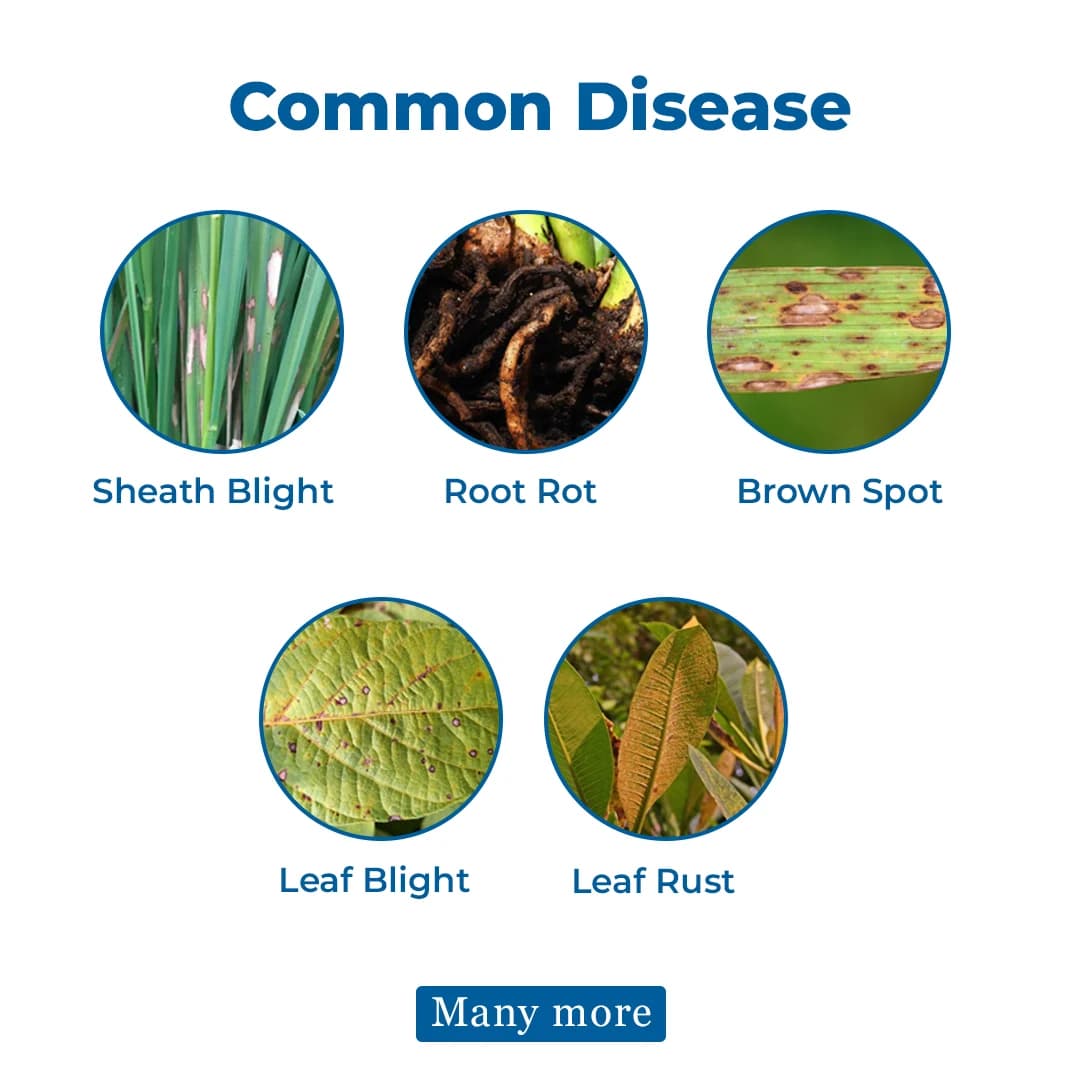
Wheat: GSP PCT 410 helps protect against leaf rust and early disease pressure linked with seed and seedling stages.
Maize: PCT 410 fungicide supports protection from leaf blight and early fungal disease risk.
Rice: GSP PCT 410 helps manage brown spot and sheath blight risk, and early crop establishment issues.
Soybean: PCT 410 fungicide helps protect against damping-off and seed rot.
Cotton: GSP PCT 410 supports protection from root rot and early pest stress.
Sunflower: PCT 410 fungicide helps manage downy mildew, rust, and early disease pressure.
Vegetable Crops: GSP PCT 410 supports protection from damping-off, seed rot, and seedling blight.
GSP PCT 410 Dose:
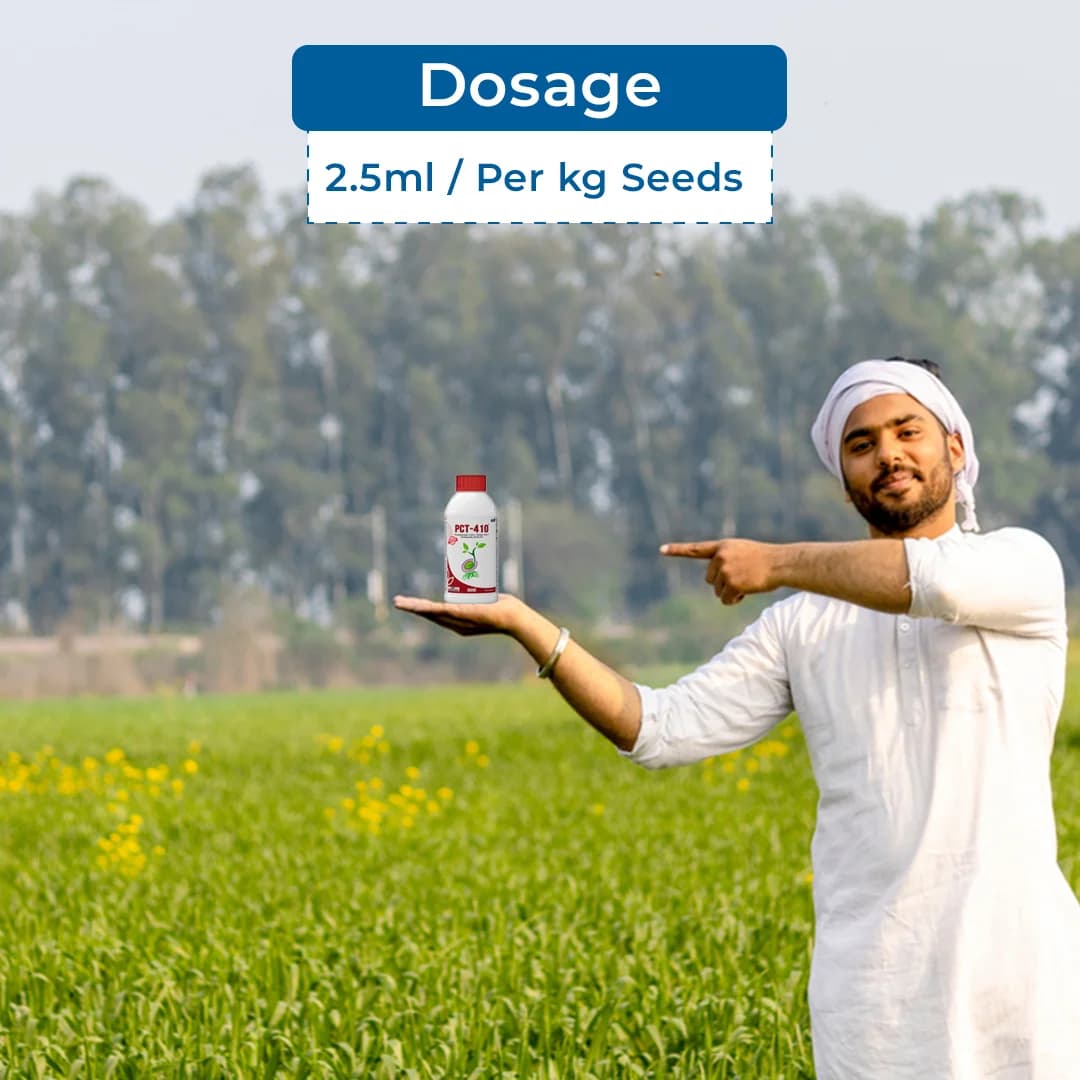
Use GSP PCT 410 only as a seed-treatment product before sowing. PCT 410 dose per litre is not the correct field unit because PCT 410 fungicide is applied on seed, not as a foliar spray. The recommended dose is generally 2.5 to 7 ml per kg of seed, depending on crop and disease risk. Mix GSP PCT 410 evenly with seed so every seed gets proper coating before sowing.
Crop | Target Disease or Purpose | Dose Per Kg of Seed | Application Method |
|---|
Wheat | Leaf rust and early disease protection | 4 to 6 ml | Seed treatment before sowing |
Maize | Leaf blight and seedling protection | 4 to 6 ml | Uniform seed coating |
Rice | Brown spot and sheath blight risk support | 4 to 6 ml | Seed treatment before sowing |
Soybean | Damping-off and seed rot | 4 to 6 ml | Seed coating before sowing |
Cotton | Root rot and early pest support | 4 to 6 ml | Seed treatment before sowing |
Sunflower | Downy mildew and rust risk support | 4 to 6 ml | Uniform seed treatment |
Vegetable Crops | Damping-off, seed rot, seedling blight | 2.5 ml | Seed coating before sowing |
How to Use GSP PCT 410:
Measure the required quantity of GSP PCT 410 as per the seed weight.
Use clean and healthy seed for better seed-treatment results.
Take the seed in a clean container, drum, or seed-treatment machine.
Add the measured PCT 410 fungicide slowly over the seed.
Mix GSP PCT 410 properly until all seeds are uniformly coated.
Dry treated seed in shade for a short time before sowing.
Do not dry treated seed under harsh sunlight.
Sow treated seed on the same day or as per label guidance.
Do not use treated seed for food, feed, or oil extraction.
Avoid direct hand contact with treated seed.
Wash hands and equipment properly after treatment.
Best Time to Apply:
Apply GSP PCT 410 just before sowing, after seed cleaning and grading. PCT 410 fungicide gives better results when it is evenly coated on healthy seed. Treat only the quantity of seed required for sowing. Avoid treating wet, damaged, broken, or poor-quality seed because field performance may be reduced.
Frequency of Application and Re-Entry Period:
Frequency of Application: One proper GSP PCT 410 seed treatment is generally enough before sowing. Do not repeat treatment on already treated seed unless label guidance allows it.
Re-Entry Period: Normal field entry can resume after sowing, but workers should avoid direct handling of treated seed without gloves.
Compatibility: PCT 410 fungicide should not be mixed with unknown seed dressers, fertilizers, or biological products without compatibility guidance.
Application Care: GSP PCT 410 performs better when seed coating is uniform, and the seed is sown in suitable soil moisture.
Resistance Care: Use PCT 410 fungicide as part of a planned seed-treatment and crop-protection program. Avoid depending only on one chemistry for repeated crop cycles.
Safety Precautions and Handling:
Read the product label carefully before using GSP PCT 410.
Wear gloves, mask, goggles, long sleeves, and protective footwear during seed treatment.
Do not eat, drink, smoke, or chew anything while handling PCT 410 fungicide.
Avoid direct contact with skin, eyes, and mouth.
Do not inhale vapour or spray mist while mixing GSP PCT 410.
Keep treated seed clearly marked and separate from normal seed.
Never use treated seed for food, feed, fodder, or household purposes.
Keep PCT 410 fungicide away from ponds, canals, wells, drinking water, and fish farms.
Wash hands, face, and exposed skin properly after treatment.
Keep children, animals, and unprotected workers away from treated seed.
Storage Instructions:
Store GSP PCT 410 in its original sealed container.
Keep PCT 410 fungicide in a cool, dry, shaded, and well-ventilated place.
Keep GSP PCT 410 away from moisture, direct sunlight, heat, and open flame.
Store away from food, animal feed, drinking water, seeds, and household items.
Keep PCT 410 fungicide out of reach of children and farm animals.
Close the bottle tightly after use.
Do not store leftover treated seed with food or feed grains.
Do not reuse empty containers for household or farm storage.
Storage Temperature: Follow the storage instructions printed on the pack.
Shelf Life: Check the pack label before use.
Product Specifications:
Specifications | Details |
|---|
Product Name | GSP PCT-410 Fungicide |
Brand Name | GSP Crop Science Pvt. Ltd. |
PCT 410 Technical Name | Pyraclostrobin 3.5% + Thiram 15% + Clothianidin 22.5% FS |
Formulation Type | FS - Flowable Concentrate for Seed Treatment |
Chemical Group | Strobilurin fungicide + dithiocarbamate fungicide + neonicotinoid insecticide |
Mode of Action | Systemic and contact seed protection against early fungal diseases and early pest pressure |
IRAC Group | Group 4A for Clothianidin |
FRAC Group | Group 11 for Pyraclostrobin and M03 for Thiram |
Recommended For | Wheat, maize, rice, soybean, cotton, sunflower, vegetable crops, and other suitable crops |
Pack Sizes Available | 100 ml, 500 ml, 1 L |
Country of Origin | India |
Shelf Life | Check pack label |
Pre-Harvest Interval | Not applicable for seed treatment |
Application Method | Seed treatment before sowing |
Recommended Dose | 2.5 to 7 ml per kg of seed, depending on crop |
Target Diseases | Leaf rust, leaf blight, brown spot, sheath blight risk, damping-off, seed rot, root rot, downy mildew, rust, and seedling blight |
Product Category | Seed-treatment fungicide and insecticide |